









Before you decide the child is not trying
Three things worth checking before you fight anything.
- Do the interruptions come from outside — A notification, a brother at the door, a question from the kitchen. For most children that is half of all interruptions, and the only half you can remove in one evening.
- Does the child know exactly what to do — Getting up from an unclear task looks identical to poor attention. One question shows the difference: “what are you supposed to do right now?”
- Do they concentrate on anything at all — If they can sit for a long time over a game, bricks or drawing, the attention mechanism works and the task is what needs attention. If it is nowhere and always has been, that is something for a specialist to observe.
Three kinds of interruption
They look the same — the child gets up from the table. The causes differ.
From outside
A notification, a conversation in the kitchen, a younger sibling at the door. The easiest to remove and the most often dismissed, because “it is only a moment”.
From inside
Thirst, an itch, a sudden thought about something else. You cannot forbid these, but you can prepare in advance and write thoughts down instead of following them.
From the task itself
The child does not know exactly what to do, so they get up. It looks like poor attention and is in fact a missing first step.
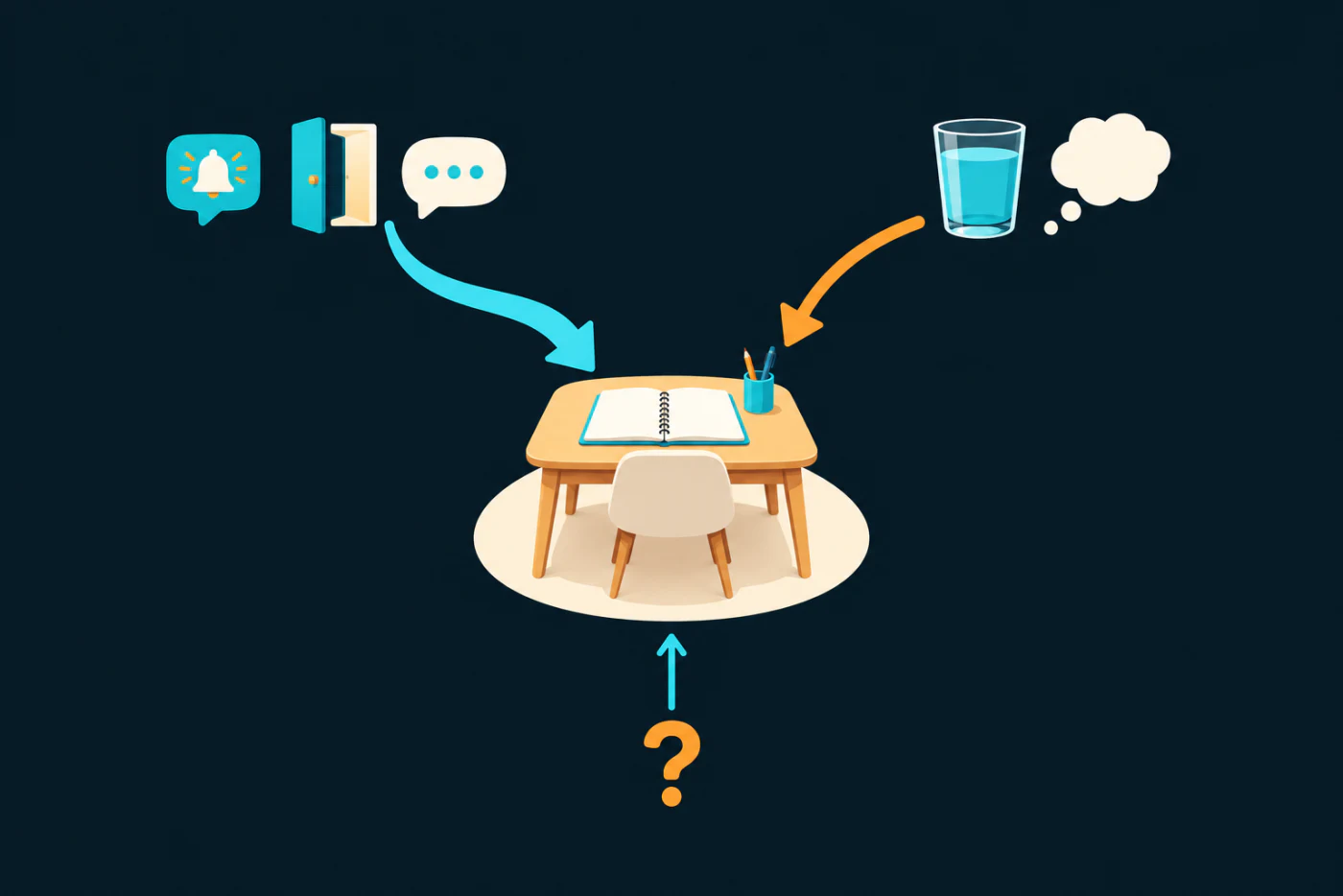 From outsideFrom insideFrom the task itself
Six steps, in this order
The first takes three evenings, the rest a few minutes each.
- Count the interruptions
A sheet beside the notebook, a mark for every break from the task and one word for what it was. Three evenings are enough to see which kind dominates.
- Set the table before the start
Water, a pen, every notebook in place. Half of the getting up is expeditions for things that could have been on the desk.
- Phone out of the room
Not in a pocket and not face down. If the child needs it for the task, it stays only for that and goes back to the other room.
- Start with the easiest step
The first five minutes on something certain to work: copying out the instruction, one simple exercise. Getting into the work is harder than the work.
- Introduce a “later” sheet
Every thought that falls outside the topic lands on the sheet as one word and comes back once the portion is finished. A written-down thought stops nagging.
- Finish before attention gives out
Better to stop two minutes early than ten minutes late. Ending on a success decides what tomorrow's start looks like.
If after a week the interruptions are in the same places and just as many, the cause is not in the room. Then look at sleep, at the difficulty of the subject itself, and if the difficulties cover everything, talk to a specialist.
One evening with a tally sheet
The same homework, the same amount of time. The difference is what the parent does with the interruptions.
An evening without the sheet
- The child gets up for water, the parent says “sit down and work”.
- Three minutes later they ask about something unrelated, the parent answers and adds “will you finally concentrate”.
- A quarter of an hour later the parent sits down beside them and starts correcting letters.
- The evening ends in the conviction that the child is not trying, and nobody has a single number.
The same evening with the sheet
- The sheet lies beside the notebook. The parent does not comment, only adds a mark and one word.
- “water”, “phone”, “brother”, “thought about the match”, “don't know what to do”.
- After half an hour there are seven marks: four from outside, two from inside, one from the task itself.
- Tomorrow's conclusion is concrete: take the phone out, put the water ready before the start, and ask about the instruction before the child sits down.
- The two “from inside” marks get the “later” sheet — the thought goes down as one word and comes back once the portion is finished.
The sheet does not improve attention. It does something else: it turns a vague “cannot concentrate” into a list of three or four concrete things, most of which can be removed.
The “later” sheet — start it tonight
Two minutes to explain, then it works by itself. The simplest tool against interruptions you cannot forbid.
- Put a blank sheet beside the notebook
Labelled with one word: “later”. Not in the phone and not in the exercise book — a separate sheet.
- Agree on the rule
Every thought that falls outside the topic — “is the match at seven”, “I need to message Kuba” — lands on it as one word. Without getting up and without a conversation.
- Read it together once the portion is done
One minute. Some of it will turn out not to matter; some you will settle on the spot.
After three days count two things: how many words land on the sheet and how many times the child got up anyway. If the getting up falls while the sheet fills, the tool is doing exactly its job — the thought does not vanish, it stops interrupting the work. If the sheet stays empty and the getting up does not fall, the interruptions come from outside, and you go back to the first three steps.
Do not read the sheet in front of the child while they work, and do not comment on what ended up there. The moment it becomes a tool of control, it stops being a tool of attention.
What the research says
Two papers that set out what we promise and what we do not.
Diamond and Ling, 2016 — a review of programmes that improve executive functions
Attention and control improve where they are practised in real activity, and for as long as they are practised. That is why this text is about the child's homework rather than exercises detached from school.
Simons et al., 2016 — a review of “brain training” programmes
The evidence for brain-training programmes is weak, and improvement usually applies to the trained task itself. A “concentration” app will not replace taking the phone out of the room.
These studies looked at training programmes, not at our course. And one thing deliberately absent from this text: the popular figures for how many minutes it takes attention to return after an interruption come from research on adult office work. So instead of someone else's numbers we suggest a measurement of your own, with a sheet of paper.
Four reactions that make it worse
Everyone does them, in good faith, usually at the end of a long day.
Reminding every two minutes
Every “get on with it” is one more interruption. An agreed check-in time works better than looking into the room.
Sitting beside them and correcting
A correction mid-task knocks them out exactly as a notification does. Mistakes get reviewed once the portion is finished.
Extending the time as a punishment
Longer work on tired attention gives less, not more. The extension punishes you as well — the evening gets longer for everyone.
Studying at the table in the living room
A place where the life of the house happens will not hold a task. Even a corner of the bedroom beats a table next to the television.
How many interruptions are normal
Roughly, over an hour of work. Compare with your own count from before the changes, not with a sibling.
| Age | How many interruptions are normal |
|---|---|
| 8–10 years | A few breaks an hour is the usual picture |
| 11–13 years | Two or three breaks an hour on ordinary material |
| 14–18 years | One break per 25–35 minutes of work |
Check attention separately from schoolwork
The free test is three game-like tasks: memory, attention and reasoning. It shows how the child copes with a task where nothing gets in the way.
Open the free testshort test, about 7 minutes · no sign-up · instant result
Where the tally sheet comes from
It is the simplest tool we hand parents before the first classes at Space Memory. The conversation about “poor concentration” changes beyond recognition when, instead of an impression, there are three evenings counted mark by mark.
Parents' questions
My child says the phone does not bother them. Who is right?
The measurement decides: three evenings with the phone in the room and three without, with marks on a sheet. An argument about feelings has no ending; an argument about numbers does.
Do headphones with music help cut out noise?
With noise from outside they can be sensible, as long as the music has no words and is always the same. A new playlist takes attention all by itself.
What if the child studies in a room with a sibling?
Agree on a quiet hour for both, or move their study times apart. Two children at one table means interruptions for both.
How long should one stretch of study last?
As long as the child actually manages today — and that is checked with a clock. A block set above what they can manage ends in getting up, not in stamina.
Do rewards for sitting still help?
Briefly yes; over time they move attention from the task to the reward. It is safer to shorten the portion to a size the child wins without a reward.
When is it a matter for a specialist?
When the difficulties show up everywhere, including in favourite activities, have lasted a long time and do not change once the conditions are sorted out.
Pages: what comes next for attention, and what about the homework evening.
Attention test for kids
Check for free which part of attention needs work.
How to improve a child's concentration
Four levers and the order to pull them in
Homework takes too long
Where the time goes during homework
Concentration exercises for kids
The same thing in ten-minute exercises
Conditions sorted out, and the work still falls apart?
In concentration training the child works in short blocks with a break and moves the line a few minutes further every week: 90 minutes once a week, in a group of 5–10. Leave a request and we will tell you about the next group.
Request a callEverything described here is done without us. The classes are for families for whom this is not enough.