
In short
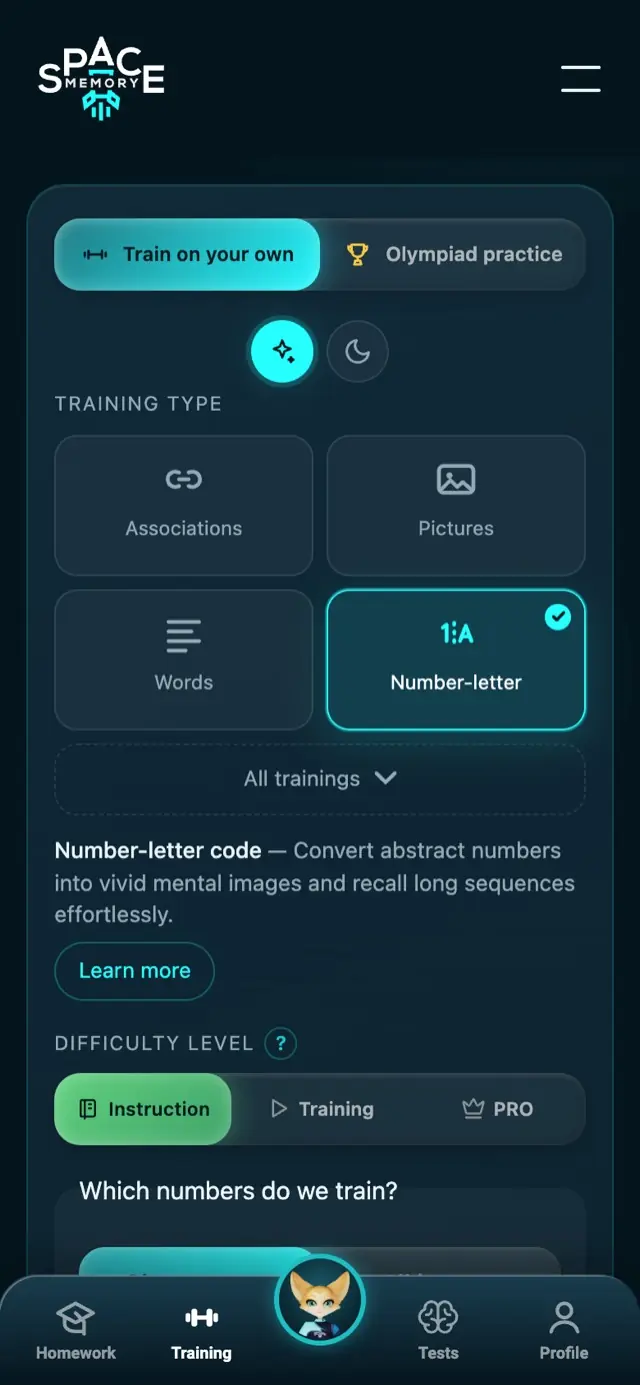
Memory training means learning specific techniques: turning information into images, linking those images into a story, and spacing repetitions over time. At Space Memory children aged 8–18 learn this in live online groups of 5–10 — 90 minutes once a week — and practise briefly every day on our platform, where each technique has its own trainer. Classes are online, so distance and city do not matter.
Why what was learned disappears
Studied in the evening, half gone by morning. It is rarely ability — it is method.
- 1Cramming without imagesText repeated aloud leaves nothing to come back to. Memory holds on to images and links, not to the sound of words.
- 2Everything the night beforeMaterial covered in one evening is gone in days. The same minutes spread across a week behave completely differently.
- 3No way to retrieveThe child "sort of remembers" but cannot pull it out. Techniques give a hook that brings the whole thing back.
What exactly we train
We do not add another school subject — we teach a method that works across all of them.
Numbers and dates
Digits become images: phone numbers, formulas and historical dates stop being strings of symbols.
Foreign vocabulary
The sound of a word is hooked to an image and a scene, so the word comes back with the picture.
Poems and texts
A text is broken into scenes and linked into a chain the child can walk from start to finish.
Terms and definitions
School concepts anchored to images, so answering in class stops being a lottery.
Exercises you can do at home
Four exercises with no materials — a sheet of paper and a few minutes a day.
- 1Ten words as imagesWrite down 10 random nouns. The task: turn each into a vivid image and link them into one story. An hour later, ask for the order back.
- 2Association chainTwo unrelated words. The child builds a bridge between them. This trains the linking everything else rests on.
- 3A walk through the flatTen places in your home in a fixed order; the child "puts" one item in each. This is the home version of a memory palace.
- 4Spaced repetitionWhatever was learned today, check tomorrow, in three days and in a week — one minute each time. The smallest change with the biggest effect.
The printable set is being prepared by our coaches — it will appear here as a download, with no sign-up and no phone number.
How the classes work
One class with a coach every week, short practice in between.
- 1Class with a coach90 minutes once a week, groups of 5–10 children, online.
- 2Daily practiceShort exercises on the platform — a separate trainer for each technique.
- 3Homework and a parent viewThe month map shows every day: done or skipped.
- 4What you needA computer or tablet and the internet. Nothing to install.
From what age, and what to expect
We start at eight: the techniques rely on confident reading and writing.
- 1Ages 8–10Images and associations, poems, times tables, first foreign words.
- 2Ages 11–13Longer texts, terms and definitions, material from several subjects at once.
- 3Ages 14–18Exam preparation, note-taking, speaking in front of the class.
Start with the free test
A 15-minute test shows memory, attention and processing speed — and gives parents a readable map of a child's strengths and weak spots. No sign-up, instant result.
Take the free test15 minutes · no sign-up · instant result
Who teaches
Space Memory was founded by Natalia and Karolina Lubenets — the team behind the Indigo Mental Club network of mental arithmetic schools. Coaches are selected strictly: one candidate in eight makes it.


What we can back up
Only what we can show.
The Indigo Mental Club team
Space Memory was built by the same team as the Indigo mental arithmetic school network.
Our own olympiads
We run olympiads for our students and prepare children for international competitions.
A certificate per level
Finish a level, get a certificate; parents follow progress on the month map.
What parents say
Real reviews from Space Memory families — with a name, a city and the child's age.
Questions and answers
Does memory training actually work?
The techniques are not a trick but a way of handling material: turn it into images, link it into a chain, space the repetitions. Results depend on regularity, which is why daily short practice sits alongside the weekly class.
What age can a child start memory training?
From 8. Younger than that the techniques have nothing to stand on: confident reading and writing come first. The upper limit is 18.
Are there memory classes for kids near me?
All our classes are online, so there is no travel involved — children join from any country.
How much practice does it take?
A few minutes a day between classes. Short and daily beats an hour once a week.
Will it help with memorising a poem?
Yes, that is one of the core uses: the poem is broken into scenes and linked into a chain.
Will it help with foreign vocabulary?
Yes — the sound of the word is hooked to an image and a scene, so the word returns with the picture.
What language are the classes in?
It depends on the group — a manager will find the right one.
Start with the free test
Fifteen minutes with no sign-up will show where the difficulty actually sits. A manager will explain the terms for your country.