








Why one technique has so many names
The oldest version of the story comes from Cicero's dialogue On the Orator (55 BC). The Greek poet Simonides of Ceos stepped out of a banquet moments before the roof fell in. The bodies could not be recognised, yet Simonides named every guest by the seat they had taken at the table. Cicero draws the conclusion that is the whole technique: the order of places keeps the order of things.
The most practical account was left by the unknown author of the Rhetorica ad Herennium, a textbook written at roughly the same time. For centuries it was credited to Cicero, which is why many languages call this "Cicero's method". The book advises choosing places that differ from one another, are neither too dark nor too close together, and marking every fifth place with a special sign so you never lose count.
Latin "loci" simply means "places". The name "memory palace" came later, in the Renaissance, when scholars built entire imaginary buildings. "Roman room" is a modern name that self-help authors gave to the version in which the whole route is a single room. The versions differ in scale, not in principle.
Why places hold a sequence
A plain list has nothing to hang on to. A route gives it a frame the child already knows.
- A place has an address — Without a route, "what was seventh?" means counting through the list from the top. With a route it becomes "what stood by the piano?" — and the answer comes straight away.
- The route supplies the order, not the material — Planets, dates or the points of a talk have no natural order that is easy to remember. A room does: right from the door, along the walls, back to the door.
- A gap shows at once — If nothing is by the mirror, you know something dropped out and which item it was. In an ordinary list a lost point often vanishes unnoticed.
Four names, one principle — how they differ
Each time it is the same idea: familiar places in a fixed order, one item in each. Only the size of the "building" changes.
Method of loci
The scientific and broadest name. Research papers and psychology textbooks use it, and it covers every version below.
Roman room
A single room whose places are the objects along the walls: door, clothes rack, mirror, armchair. The easiest start, because the whole room is visible from one spot.
Memory palace
Several rooms joined into one route, sometimes a whole house. It holds more material but needs every room to be well known. How to build one at home with a child — we wrote about it separately.
Journey method
A route outdoors: the way to school, bus stops, shops along a street. Same principle, the places are just further apart.
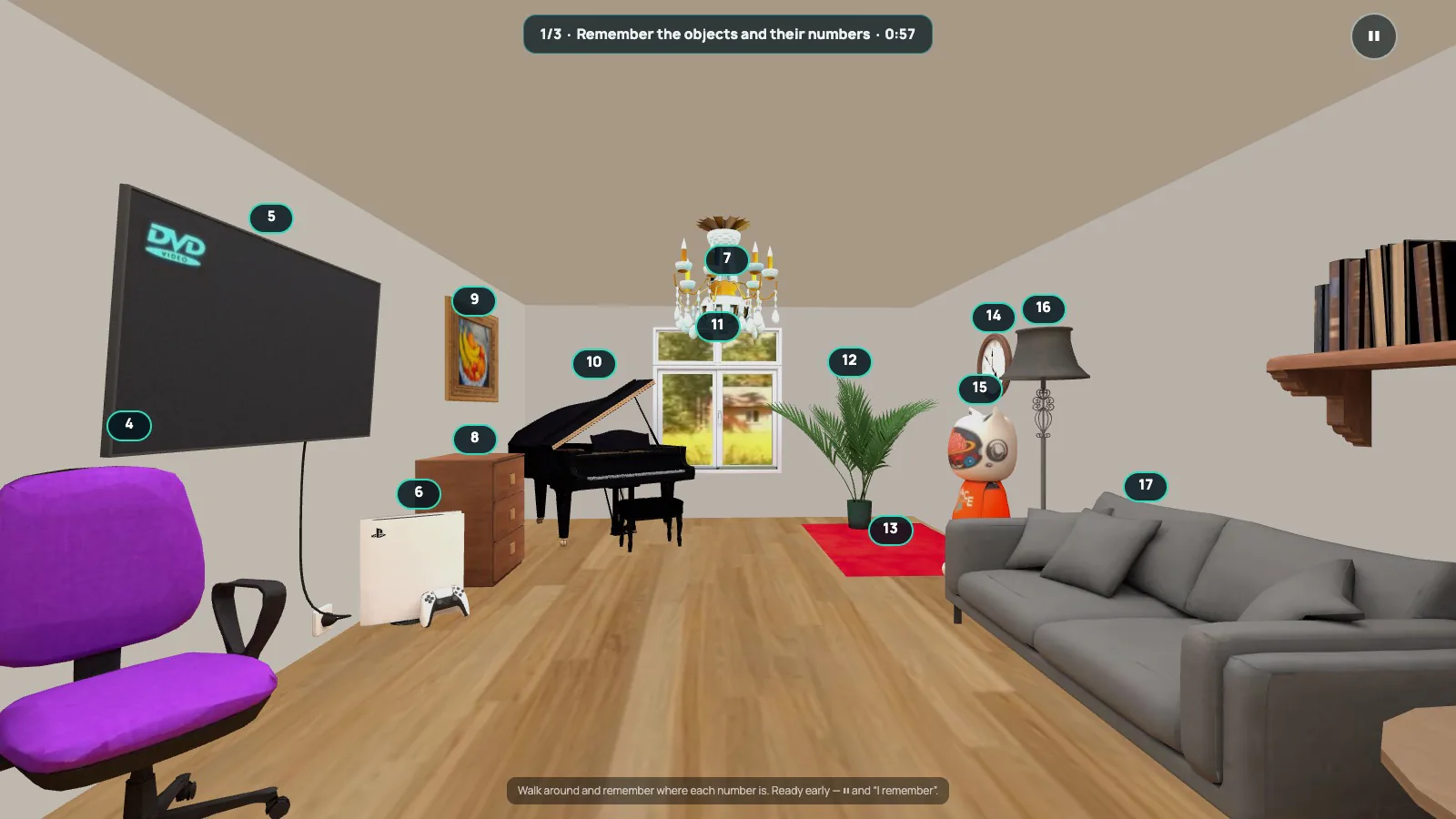
How to practise the method of loci in a 3D room — six steps
The room is ready-made, so the child does not have to build a route first. From the first minute they practise the hardest part of the technique: going through the places in order and recalling what was in them.
- Start with fewer places
At the Instruction level you choose how many objects take part — from a few up to all twenty. Do the first attempt on a short route and lengthen it afterwards.
- Walk the route from the door
Remember stage: each object shows its number. The child walks round the room (keys and mouse on a computer, a finger on a phone) and links each number to a place. There is a minute for this by default.
- Rebuild the empty room
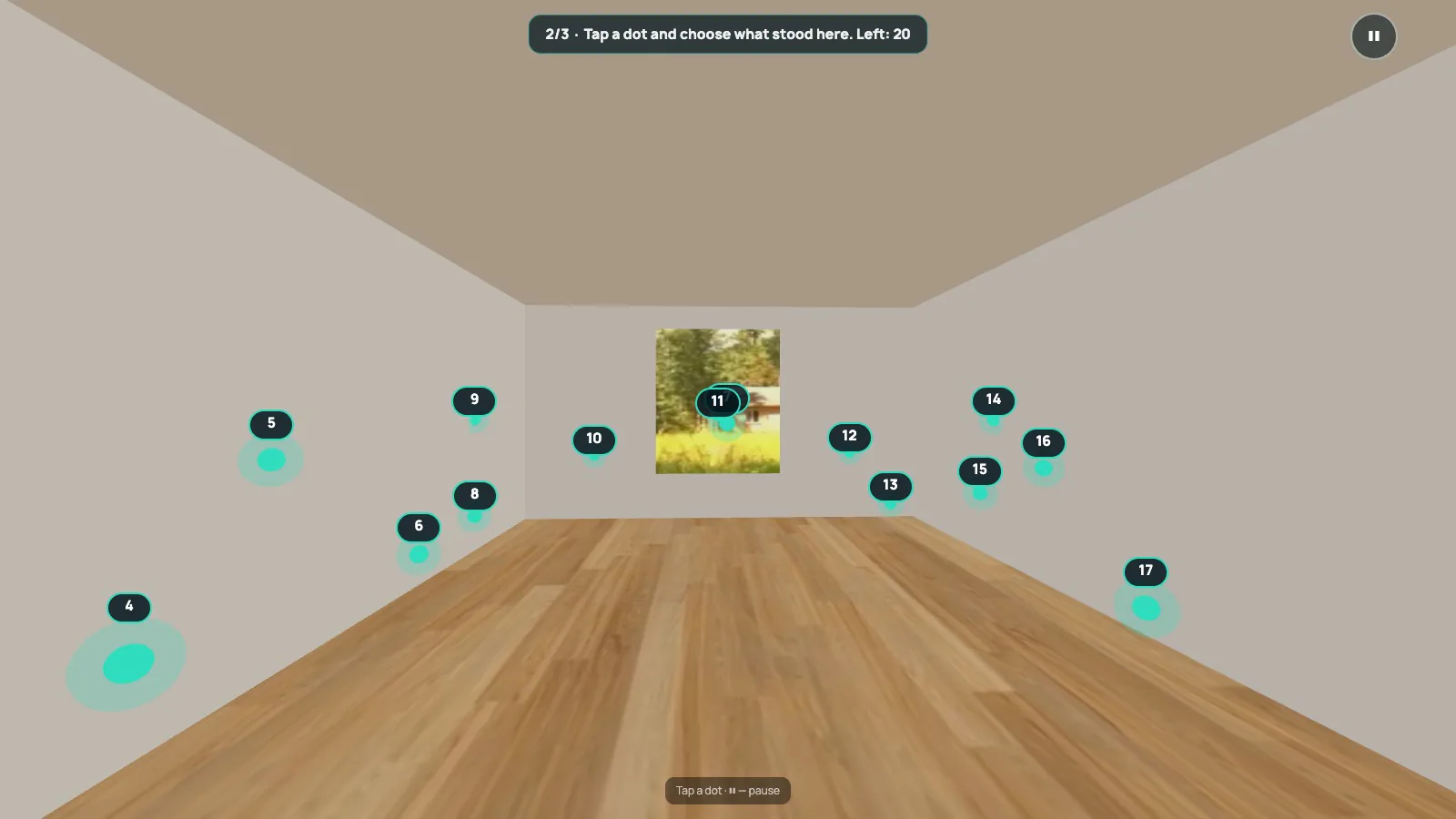
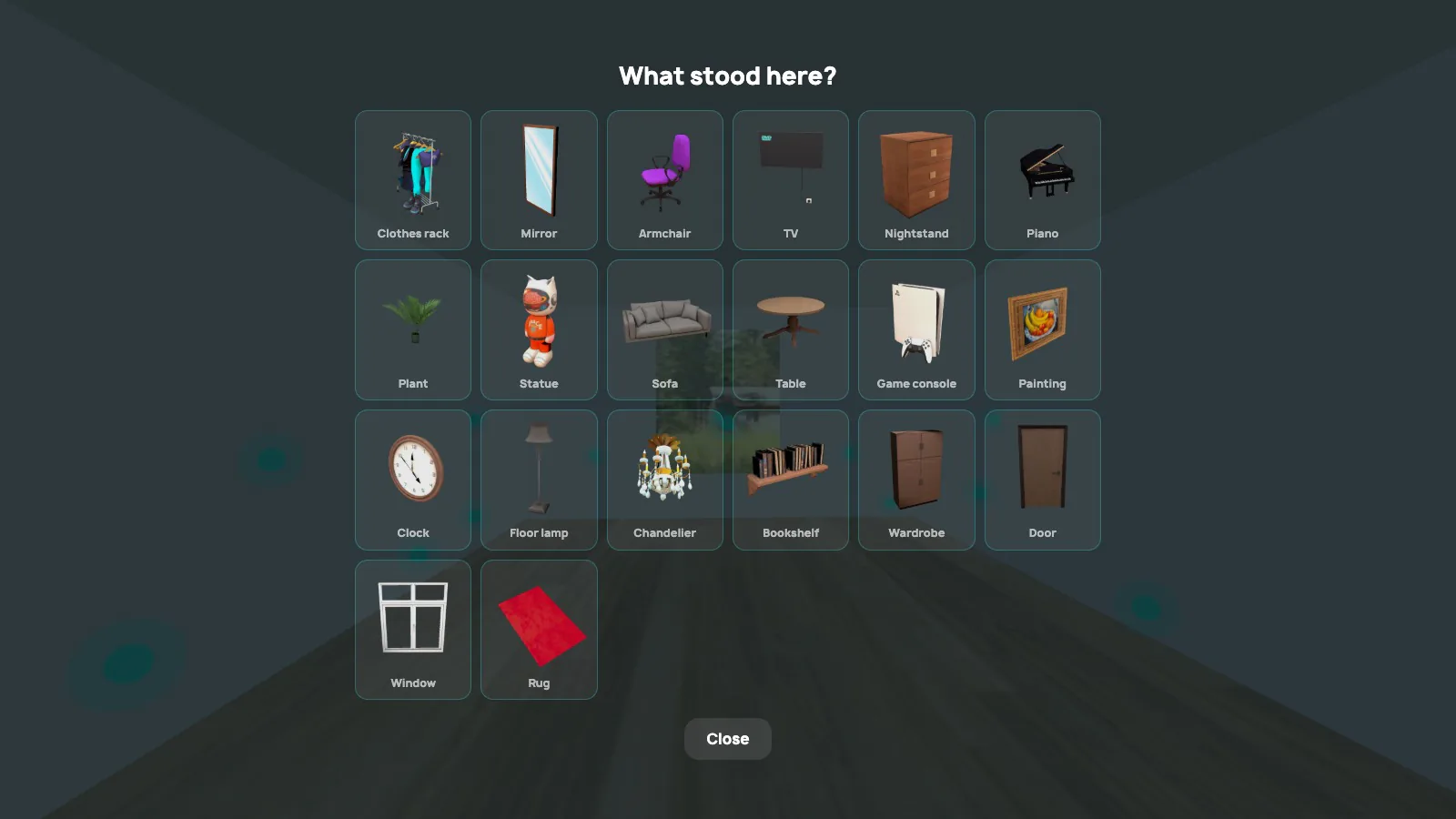
Restore stage: the objects disappear and numbered dots remain. For each dot the child chooses what stood there. This is the heart of the method of loci — the place brings back the item.
- Find by number
Find stage: a number is called and the child goes to the right object — first, second and so on. This trains the reverse direction: from the number to the place.
- Put numbers on the route
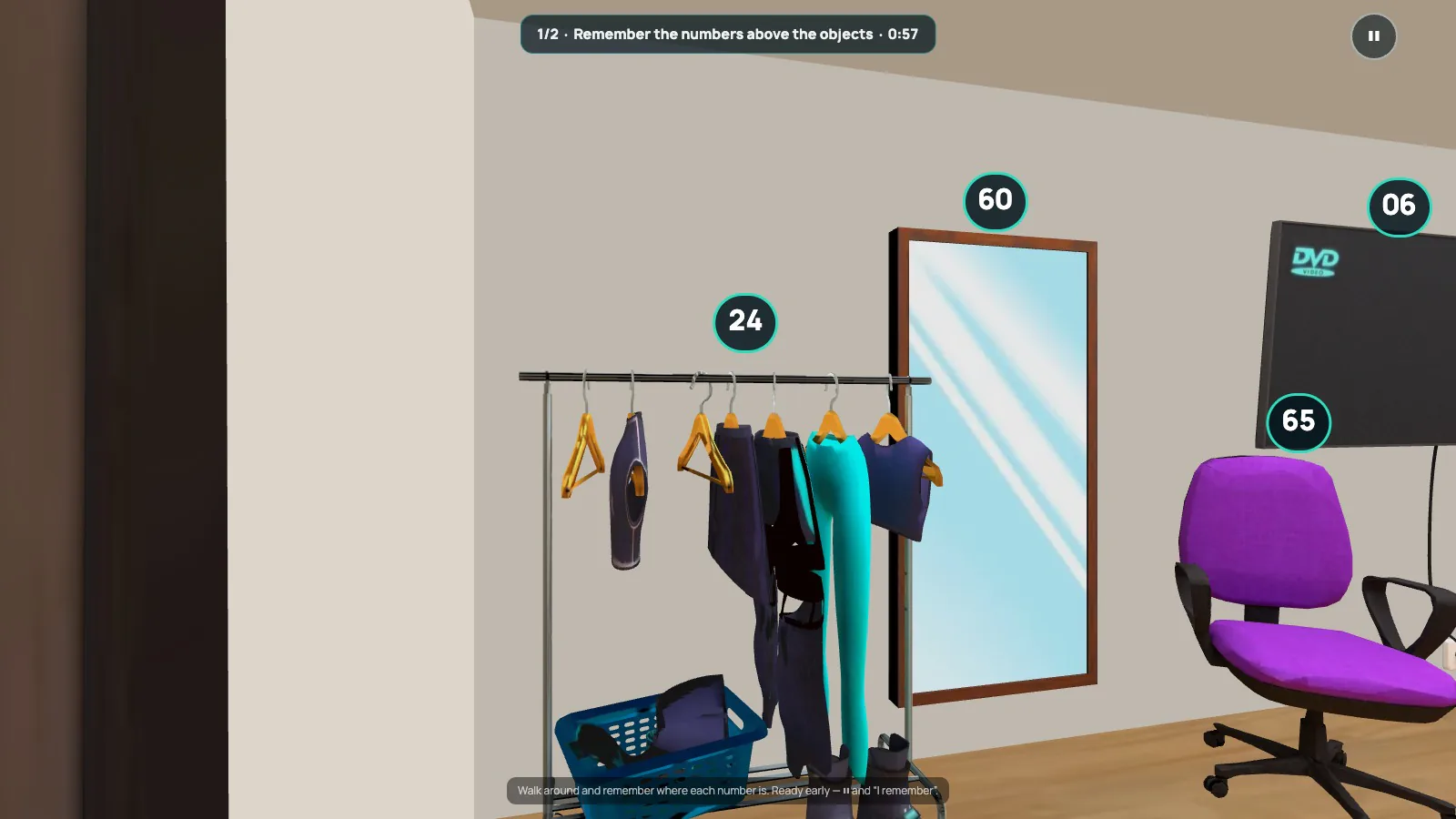
Training level: numbers from 00 to 99 appear above the objects, then disappear. First picking from a list, then typing them in, and finally rows of numbers, as in a memory olympiad, to be laid out around the room.
- Move the route into your own home
Once the 3D room goes without stumbling, the child lays out the same kind of route at home: door, clothes rack, mirror… The virtual room teaches moving along a route; the home route carries school material.
The same room always has the same order of places. After a few attempts the route stops costing effort, and in later games all the attention goes to whatever is placed on it.
Sources: from Cicero to brain research
Two texts where the technique is first described, and one study of who uses it today.
Cicero, On the Orator, book II (55 BC)
The Simonides story and the principle that the order of places keeps the order of things. Latin text at The Latin Library.
Rhetorica ad Herennium, book III (c. 85 BC)
The oldest step-by-step guide: which places to choose, how far apart, and why to mark every fifth one. English translation in the University of Chicago's collection.
Maguire et al., 2003 — the brains of memory champions
Top memory competitors did not have higher intelligence or differently built brains than a comparison group. What differed was how they worked: most of them memorised with the method of loci.
The study is about adults who trained for years and about the technique itself, not about our trainer. The 3D room does not "improve memory" on its own — it gives a child a convenient place to practise a method whose effect these papers describe. The full list of research behind our programme: the Space Memory method
What the 3D room on the platform includes
The Memory Palace trainer is this room on the Space Memory student platform. Children use it in lessons, at home as an assignment from their coach, or on their own as part of ten minutes of practice a day.
Instruction — objects
Three stages: remember the numbers, restore the vanished objects, find them by number. The number of places is set before the game.
Instruction — number-letter code
A number and a picture from the number code appear above the objects; afterwards the child matches each number to the right picture. A bridge between the route and memorising numbers.
Training — numbers
Three formats: pick the number from a list, type it in, or rows of numbers as in an olympiad. Answers can go in route order, from the door, or in any order.
On a computer and on a phone
W, A, S, D and the mouse on a computer; on a phone the left side of the screen walks and the right side looks around. The room also works with a phone held upright.
What a virtual room will not do
The trainer makes the start easier, but some of the work stays with the child.
It will not invent images
In the 3D room the objects and numbers are given. With school material the child turns each idea into a vivid, moving image themselves, and that needs separate practice.
It will not replace personal routes
One room is twenty places. A history test or a presentation will need routes at home, at school, on the way there.
Numbers are practice, not the goal
Memorising numbers on a route trains speed and order. It pays off when the same skill handles dates, formulas and lists from lessons.
A long session will not speed things up
A few short games a week do more than one hour-long sitting. A tired child starts guessing instead of recalling.
From the 3D room to school material
A typical path for a student. The pace depends on age and on how often the child goes into the room.
| Stage | What the child does |
|---|---|
| First weeks | Instruction on a shorter route, then on all twenty places. Goal: walk the room from the door without thinking. |
| Following weeks | Training with numbers: picking from a list first, then typing. Plus the number-letter code. |
| After that | Personal routes at home with school material on them: dates, stages, points of a talk. Rows of numbers for those preparing for an olympiad. |
Before entering the room — check working memory
The method of loci loads working memory and attention: the child holds a place and an item in mind at once. The free test shows how they cope with both.
Take the free testthree short games, about 7 minutes · no sign-up · instant result
Who wrote this
We built the 3D room so that the first step of the method of loci would not require a child to invent and memorise a route of their own. A ready-made room moves that step to later: first the child learns to walk a route, then builds one. Written by the Space Memory methodology team.
Questions and answers
Are the method of loci and the memory palace the same thing?
Yes. Method of loci is the scientific name, memory palace the everyday one, and the Roman room is its single-room version. The principle is shared: familiar places in a fixed order, one item in each.
Why is it called Cicero's method?
Cicero described it in On the Orator, and the oldest practical textbook of the technique was for centuries thought to be his. He did not invent it himself — he credited the Greek poet Simonides.
How is a Roman room different from a memory palace?
In scale. A Roman room is one room with a dozen or a few dozen places. A memory palace joins many rooms into one route and holds more, but is harder to build at the start.
Why a virtual room when we have our own home?
So that the first exercises do not depend on how well the child built a route. In the 3D room the route is ready and always the same, and the game checks the answers immediately. The home route comes later, for school material.
From what age can a child manage the 3D room?
Our students are 8–18. The youngest start on a shorter route at the Instruction level; older ones move quickly to training with numbers.
Is the 3D room available without the course?
No. It is a trainer on the student platform that children use in lessons and between them. Without signing up you can take the free memory and attention test and try the technique at home using our guide to building a memory palace.
How much practice a day makes sense?
On the platform we suggest about ten minutes a day between lessons. One game in the 3D room at the Instruction level takes a few minutes.
More on memory
- How to improve memory for kids
- How to memorize multiplication tables
- Why children forget so quickly
- A child who does not remember what they studied
What next
How to build a route of your own and what images will stay on it.
Memory course for kids
The same techniques in weekly classes with a coach, on material from school.
Memory training for kids
What memory training is and what a child practises in class.
Memory test for kids online
Check for free how your child remembers now — before you start practising.
Memory palace for kids
Six steps to a first route at home, and the mistakes that stop the technique working the first time.
Mnemonics for kids
The images and associations you place on a route. Without them the places stay empty.
The solar system for kids
Eight planets in order is classic material for a first route. The platform has an interactive model of the planets for it.
The 3D room is waiting on the platform
In lessons a child moves from images and associations to routes, and practises in the 3D room between sessions. Online lessons once a week for 90 minutes, in groups of 5–10 children aged 8–18.
Request a callA manager will call and answer your questions