






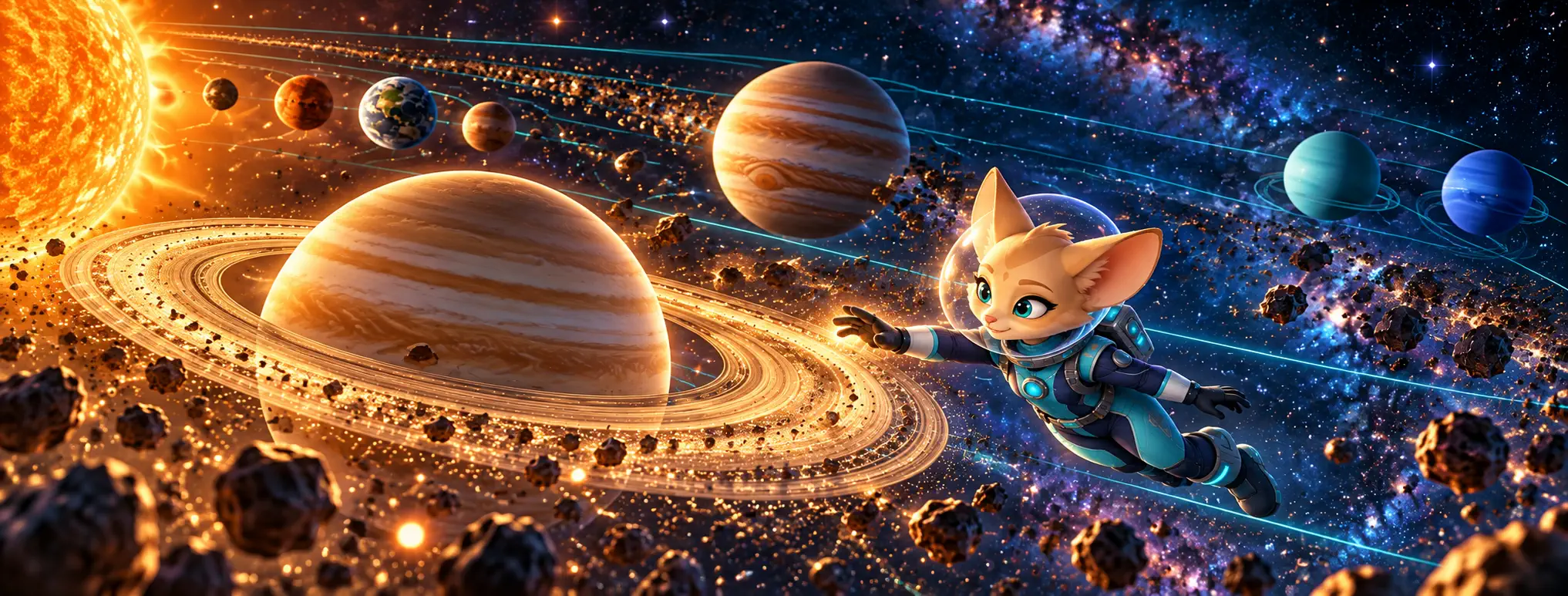
Why a memory school has planets
The solar system is one of the first big sets of facts a child is asked to remember at school.
- The order of the planets is a classic list — Eight names in a fixed order — exactly the kind of material used to practise the memory palace and association chains.
- Numbers without an image don't stick — “Radius 69,911 km” is gone in a minute. “Eleven Earths across” stays — which is why the cards speak in comparisons.
- Curiosity beats pressure — A child taps Jupiter on their own to see a storm bigger than Earth. Facts they reached for themselves last longer than facts from a list to cram.
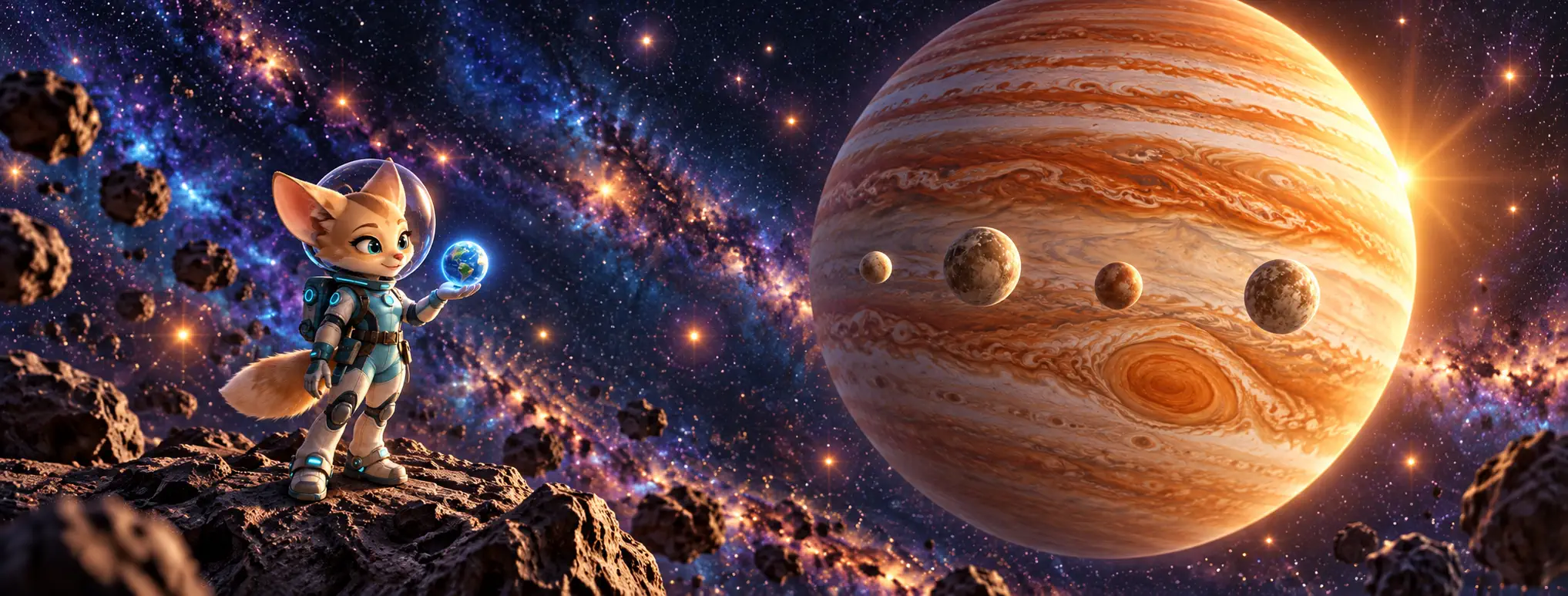
Four facts from the cards
Picked from the cards in the model. Every number checked against NASA Science.
The Sun is almost everything
It holds 99.8% of the mass of the whole solar system. All the planets together are a crumb.
The footprints on the Moon are still there
There is no wind or rain to wipe them away. The last people were there in December 1972.
A moon bigger than a planet
Ganymede, Jupiter's largest moon, is bigger than Mercury.
A storm older than your great-grandparents
Jupiter's Great Red Spot has raged for at least 190 years. It once could have held three Earths; today, one.
What the child can do in the model
Button names are given as the student sees them.
- Enters from the hangar
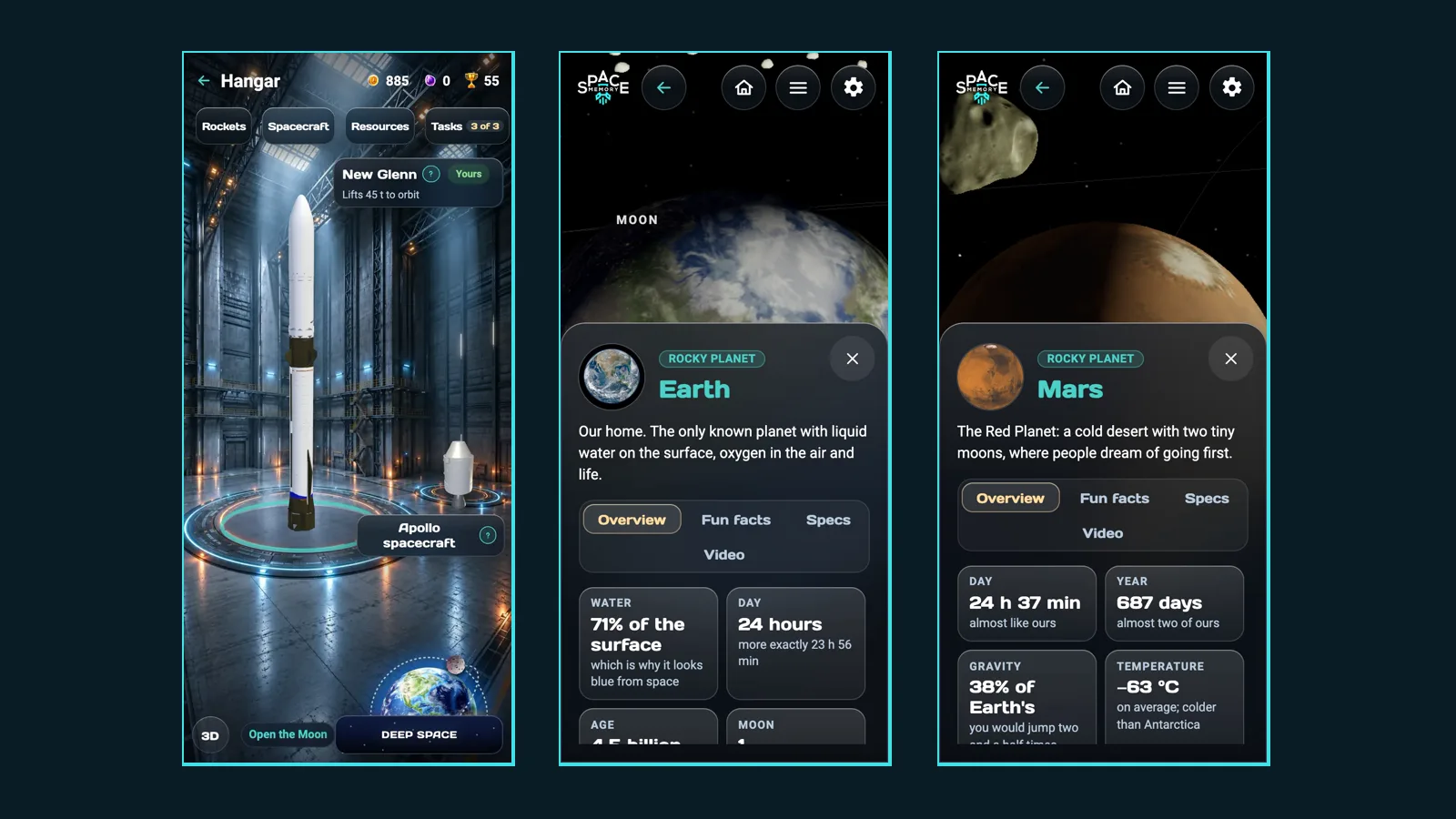
In the My Space hangar there is a “Deep Space” button. It opens the whole system; “Whole system” returns to the top view, “Back to the hangar” goes back to the rockets.
- Picks a celestial body
There are 17 to choose from: the Sun, Mercury, Venus, Earth, Mars, Jupiter, Saturn, Uranus, Neptune, Pluto, the Moon, Io, Europa, Ganymede, Callisto, Phobos and Deimos. The asteroid belt and the Kuiper belt are visible between them.
- Reads the card: “Overview” and “Fun facts”
“Overview” is four tiles with a comparison: Mars has 38% of Earth's gravity — you would jump two and a half times higher. “Fun facts” has five or six facts with numbers and a timeline of discoveries, from Galileo to today's probes.
- Checks “Specs” and watches the “Video”
“Specs” lists radius, mass, day, year, temperature and who has been there. The card also shows the distance from Earth today and how long the ship from our Artemis mission would take to get there. “Video” links to a NASA or ESA video on YouTube.
- Speeds up time
The time bar has seven speeds: paused, real time, an hour, a day, a week, a month and a year per second. At a year per second you can see Mercury go round the Sun four times while Earth makes one lap.
- Checks their birthday
The “My birthday” button sets the planets where they stood on the day the child was born. Any other date works too — the Apollo 11 landing, for example.
The model runs in the browser, phones and tablets included. It needs 3D graphics: on a very old device a message appears instead of space.
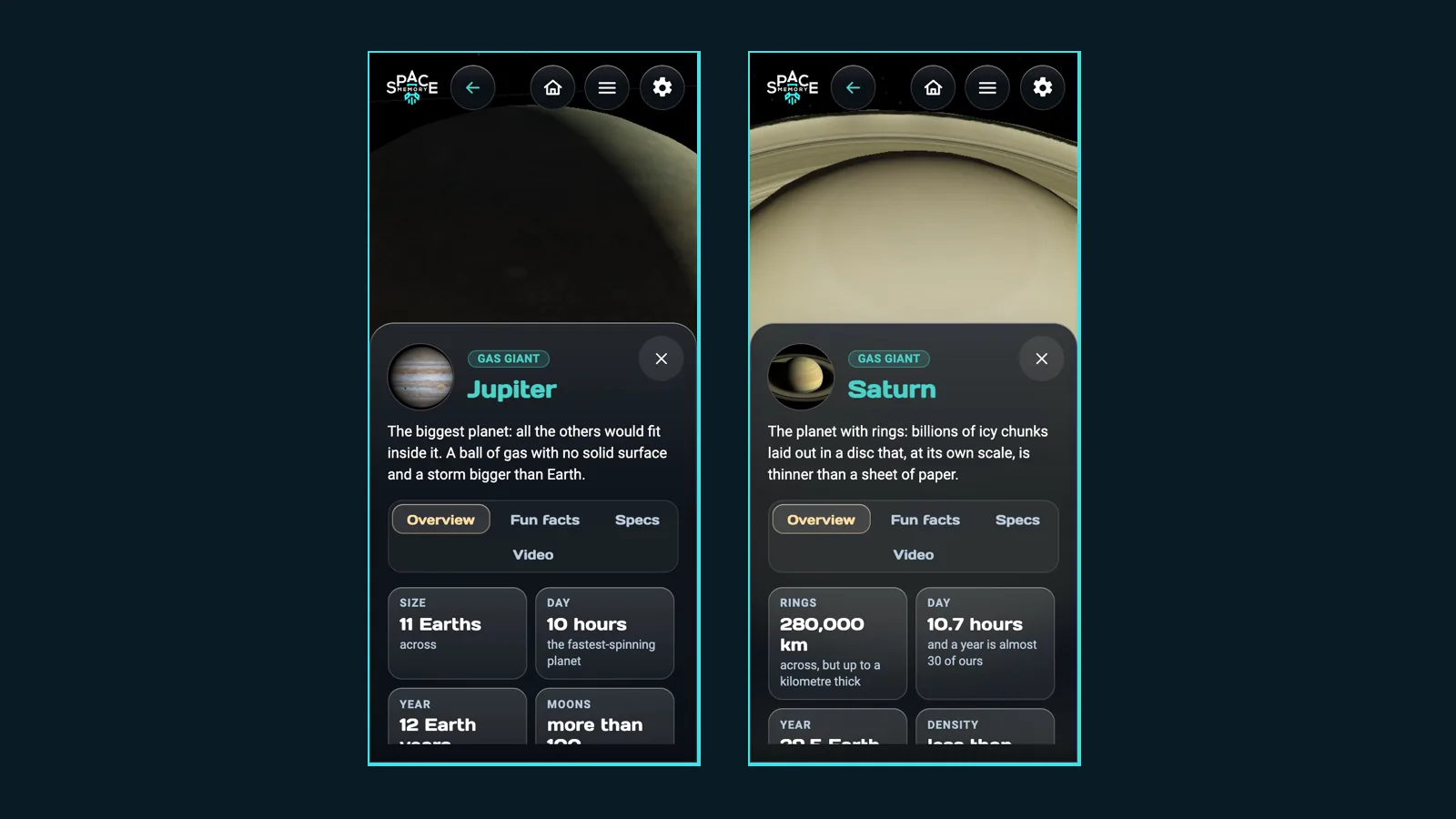
Jupiter in a textbook and on the card
The same facts about the largest planet, told two ways. The first is easy to read, the second is easy to remember.
Like a table
- Radius: 69,911 km.
- Rotation period: 9 h 56 min.
- Orbital period: 11.9 years.
- Number of moons: 101.
Like the card
- Size: 11 Earths across.
- Day: 10 hours — the fastest-spinning planet.
- Year: 12 Earth years — Jupiter is in no hurry.
- Moons: more than 100; the four big ones were found by Galileo.
The numbers in both columns are the same. The second one simply hooks each number to something familiar — the same principle we teach in class.
The order of the planets in one sentence
The simplest route to eight names in order is a sentence where each word starts with the same letter as a planet. Five minutes, then a check in the model.
- Say the sentence aloud
“My Very Educated Mother Just Served Us Nachos.” Two or three times, until the child can say it without the sheet.
- Match the letters to the planets
M — Mercury, V — Venus, E — Earth, M — Mars, J — Jupiter, S — Saturn, U — Uranus, N — Neptune. The two Ms are told apart by place: the first is next to the Sun, the second just past Earth.
- Turn the sentence into a picture
A very serious mother in a graduation cap handing out a plate of nachos. An image holds the sentence better than repetition alone.
- Check it in the model
In the solar system on the platform the child taps the planets from the Sun outwards and names each one before opening its card.
The next day the child names all eight planets in order without saying the sentence aloud. If the two Ms get mixed up, go back to step two: Mercury is first from the Sun, Mars comes right after Earth.
A sentence gives the order, not the facts. When the child needs to remember something about each planet, a memory palace works better — the article is in the links below.
Sources
Where the numbers on the cards and the planet positions come from.
NASA Science — Solar System
Descriptions of the planets and moons we checked the card facts and numbers against.
NASA — Planetary Fact Sheet
Radius, mass, day, year and distance for every planet. The source of the “Specs” tab.
JPL — approximate positions of the planets
The orbital elements the model uses to place each planet on the chosen day.
NASA — the VIPER mission
The rover that lands near the Moon's south pole in the game.
What the model doesn't have
So nobody promises a child more than there is.
Flights to the planets
Planets can be explored and read about, but the only place you can fly is the Moon, on the mission from the hangar.
The Moon straight away
The Moon's card stays locked until the child builds a rocket, buys the lander and the rover, and fills the tank with practice sessions.
Every moon
Jupiter has more than a hundred; the model shows the four largest. Saturn, Uranus and Neptune appear without moons.
A science lesson
It is a place to look and wonder, not an astronomy course. There are no tests or marks.
How long the ship from our mission would fly
In the game the flight to the Moon takes three days, as in real missions. At the same speed, about 5,300 km/h, the further targets look like this. It is simple arithmetic: real probes fly on curved paths and much faster.
| Target | At our mission's speed |
|---|---|
| The Moon | 3 days. |
| Mars, when closest to Earth | Over a year. |
| Jupiter, when closest | About 12 years. |
| Neptune | Over 90 years. |
Check your child's memory in seven minutes
How much a child keeps from the cards depends on memory and attention. The free test shows how they are doing — in seven minutes, with no sign-up.
Take the free testshort test, about 7 minutes · no sign-up · instant result
Who wrote this
Prepared by Natalia Lubenets with the team that develops the student platform. The card texts were checked against NASA Science, and planet positions are computed from JPL orbital elements — sources are below. The screenshots come from the real platform, not mock-ups.
Questions and answers
Where is the solar system on the platform?
In the My Space game: the hangar, then the “Deep Space” button. The model is part of the student platform and is included in the course.
Are the planets in their real places?
Yes. Positions are computed from real orbital elements for the chosen day, so the planets' arrangement and the distance from Earth on the card are real.
Where do the data and facts come from?
The numbers on the cards were checked against NASA Science; the videos are mostly from official NASA and ESA channels.
What age are the cards for?
The texts were written for children aged 8–14: short sentences and comparisons with things a child knows. Older children use them too, especially the “Specs” tab.
Can the child fly to Mars?
No. The game has only the mission to the Moon. Mars and the other planets can be explored, the card read, and the specs show how long such a flight would take.
Does it work on a phone?
Yes, in the browser. The model needs 3D graphics; on a very old device a message appears instead of space.
What next
How to remember the order of the planets and what else is in the game.
Memory palace for kids
The eight planets along a route through your home — step by step.
The My Space game
A character, a hangar with real rockets and coins for homework.
Mnemonics for kids
Images, associations and chains — what every list to remember rests on.
The order of the planets sticks in class
In the model a child looks and asks; in class they learn how to keep it in their head. The first lesson is free — a manager will suggest a time.
Request a callA manager will call and answer your questions