








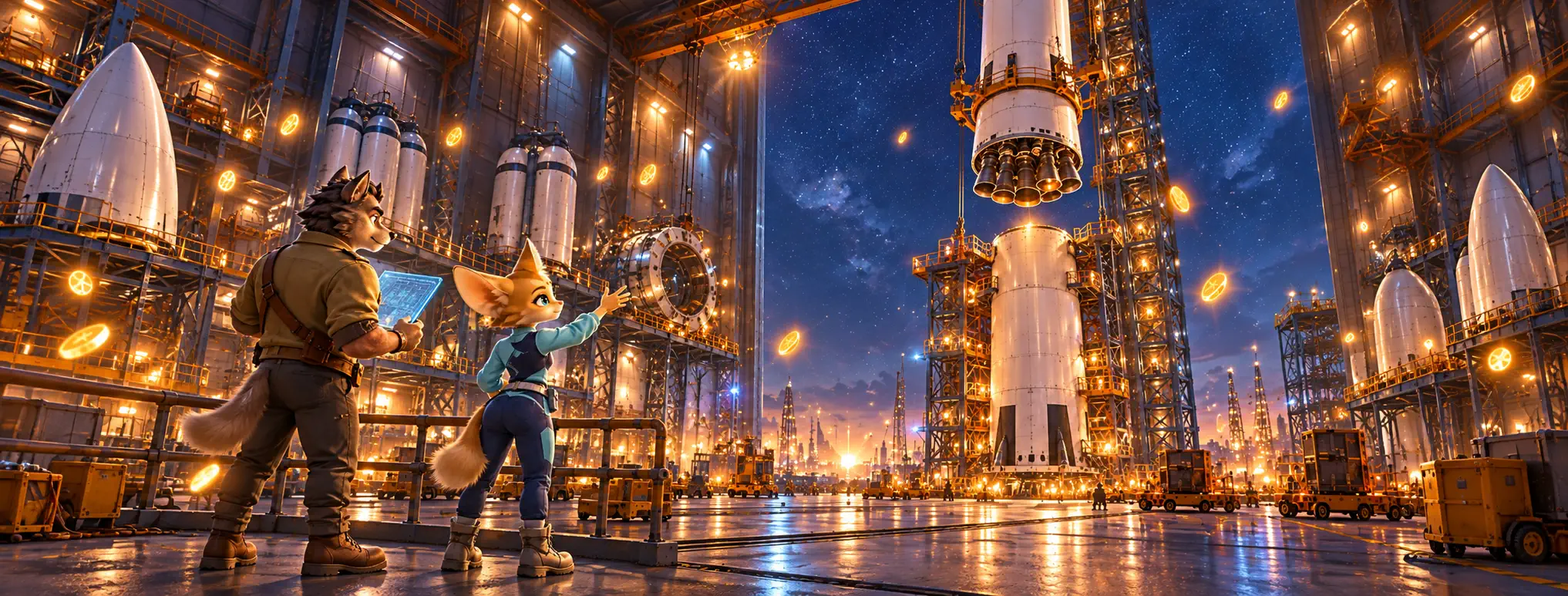
Why a memory school has a game
Children learn a technique in class and consolidate it at home, about 10 minutes a day. The game is there so those 10 minutes don't depend on reminders.
- Homework gets boring after a month — The first weeks run on curiosity. After that a child needs a goal longer than one evening — say, a rocket they are saving up for.
- Rewarding regularity, not results — Coins come for doing the task that day. A child who works more slowly earns as much as the fastest in the group.
- Parents don't have to police it — The coin and cup counters show whether homework is being done. No daily interrogation — the conversation starts with the rocket, not with reproaches.

What earns coins and what doesn't
One rule: finished work is rewarded, screen time isn't.
A day of homework — 10 coins
It counts when every task the coach assigned for that day is done. Half a day's work is not a day.
The whole week — 25 more
The homework week starts the day after the class. The bonus arrives when everything set for that week is finished.
A finished rocket — 200 coins
A reward for seeing a goal through. It covers the first modules of the next, bigger rocket.
No coins: just sitting in the game
An hour in the hangar earns nothing. Coins can't be bought with money either — there is one way, through homework.
What the child does in the game
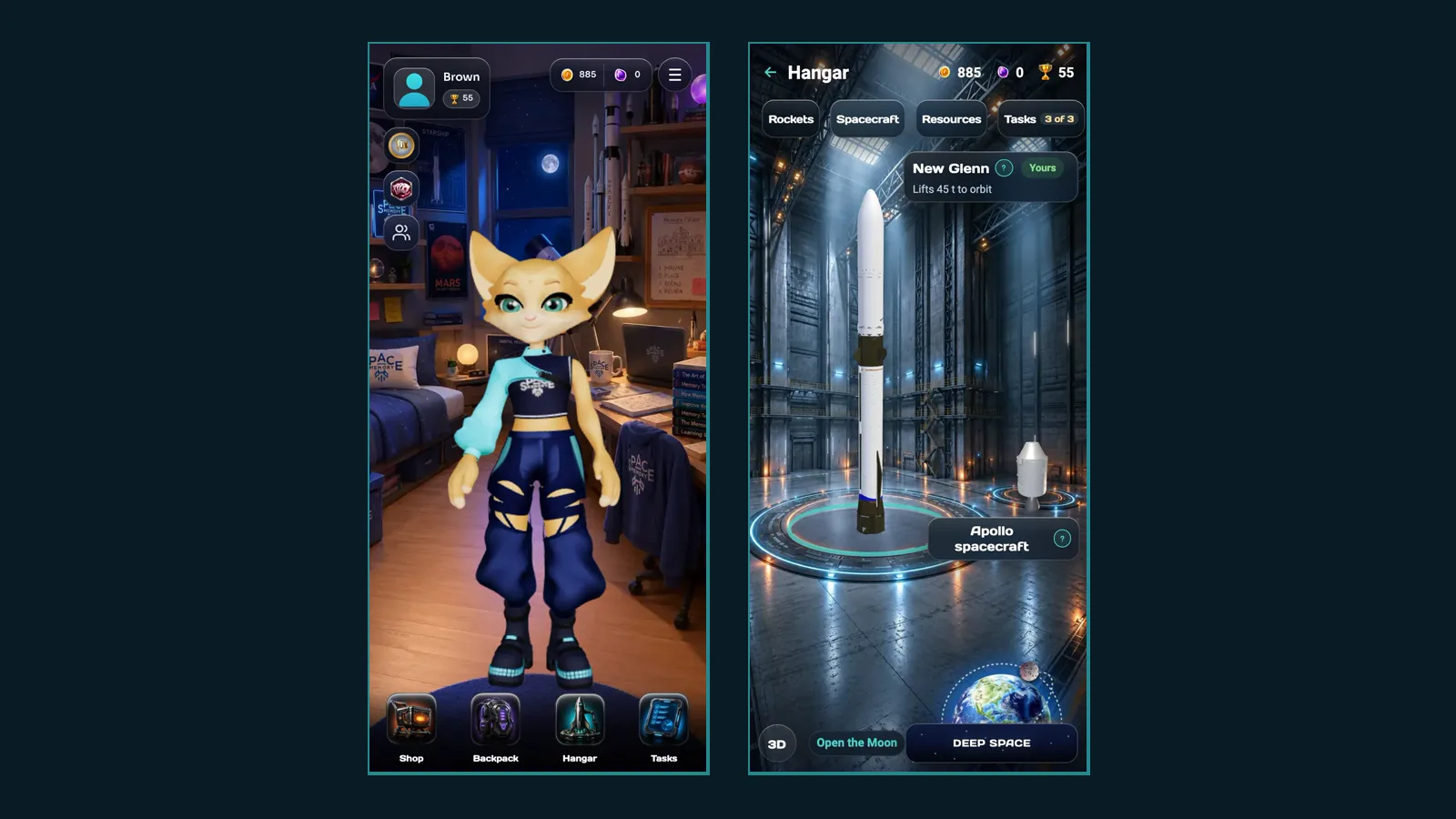
Six things that are in the game today. Button names are given as the student sees them.
- Picks a character
The starting character is Spacey, a fennec fox girl — free. Under “Characters” the child can later buy others with coins: an older Spacey, Spike the wolf and Kicia the cat. All characters are 3D.
- Dresses it and sets the scene
“Hero's Clothing” has jackets, overalls, boots and accessories. There are also “Moves and Emotions”, “Backgrounds” — cities, summer, winter, autumn — and background music. Instead of a character the child can use their own photo as an avatar. Purchases go into the “Backpack”.
- Earns coins with homework
10 coins for a day when all assigned homework is done, and another 25 when everything the coach set for the week is finished. A few coins also come for first steps in the game: changing the avatar, the first outfit, the first character.
- Builds a rocket in the hangar
The “Hangar” holds real rockets: Electron, Ariane 6, Falcon 9 and Saturn V are built bottom-up, module by module — engine, body and tanks, upper stage, avionics bay, fairing. New Glenn, Zhuque-3 and the Space Shuttle are bought whole. Every finished rocket earns 200 coins.
- Chooses a payload for it
Under “Spacecraft” there are real probes and ships: Voyager, the James Webb Space Telescope, the Curiosity rover, Cassini, the Apollo spacecraft. A payload fits a rocket only if its real mass is within the rocket's real lift capacity — which also shows why Saturn V had to be so huge.
- Climbs in rank and collects cups
Rank depends on memorisation speed in the number-letter code homework, not on how many tasks are done. Cups count finished homework; the cups ranking has two views — your own group and the whole country.
The game is part of the student platform and runs in the browser, phones included. Nothing to install and nothing extra to pay.
What the game doesn't do
We say it plainly so nobody expects the wrong thing.
It doesn't train memory by itself
Classes and trainers do that. The game only rewards the fact that practice happened.
It doesn't replace classes
Children learn the techniques with a coach, in a group, 90 minutes a week. Without classes there is nothing to earn coins for.
It doesn't reward screen time
The longer a child stays in the game, the more they don't get. So there is no reason to sit there for hours.
It doesn't show surnames
The cups ranking shows only game nicknames. Children's real names never appear there.
How much work a rocket takes
Roughly, with homework done every day of the week. The school sets the prices and they can change.
| Rocket | Roughly |
|---|---|
| Electron, the smallest | About a week of regular homework. |
| Falcon 9 | About six weeks, counting the reward for the previous rocket. |
| Saturn V, the biggest to assemble | Several months. A goal for a term, not a weekend. |
Check your child's memory in seven minutes
The game rewards regularity, but it helps to know the starting point. The free test shows how the child does with memory and attention — in seven minutes, with no sign-up.
Take the free testshort test, about 7 minutes · no sign-up · instant result
Who wrote this
Prepared by Natalia Lubenets with the team that develops the student platform. Every number — coins, rewards, rockets — was checked against the game's code on the day of publication, and the screenshots come from the real platform, not mock-ups. When something in the game changes, we update the text.
Questions and answers
Does the game cost extra?
No. The game is part of the student platform and is included in the course. Coins can't be bought with money — they are earned only through homework.
What does the child get coins for?
10 coins for a day when all assigned homework is done, 25 for completing the whole week and 200 for every finished rocket. A few coins also come for first steps in the game.
Won't my child sit in the game for hours?
The game doesn't reward time: an hour in the hangar earns no coins. To buy the next module the child has to go back to homework, which takes about 10 minutes a day.
Are the rockets and spacecraft real?
Yes. Each rocket models a real design with its real lift capacity — New Glenn, for example, carries 45 tonnes to orbit. A payload fits only if its real mass allows it.
What does rank depend on?
On memorisation speed in the number-letter code homework — the best time counts. The number of finished tasks is a separate counter, the cups.
Does the game work on a phone?
Yes, in the browser, with no app to install. The screenshots in this article are from a phone.
What next
Where reluctance to study comes from and what we do in class.
Child has no motivation to study
Where it comes from and what helps, before any rewards.
Homework takes too long
Where the time goes during homework and how to get it back.
The Space Memory method
What the classes look like where children learn memory techniques.
The game makes sense together with classes
Coins in My Space are for homework after classes with a coach. The first lesson is free — a manager will suggest a time.
Request a callA manager will call and answer your questions