









Three different things called «poor concentration»
Telling them apart takes an evening and saves months of practising the wrong thing.
- Starts and does not come back — Sits down, works for a few minutes, gets up for water and never returns. That is a problem with returning to the task, not with concentrating as such.
- Sits there, but nothing comes of it — An hour at the desk and half a page in the notebook. The attention is at the table but not on the task — usually because the task is unclear.
- Concentrates only on what they like — With a game or building blocks they can sit for a long time. That is important information: the mechanism works; the problem is with what is supposed to hold their attention.
Four levers you actually control
In order from the cheapest. Pulling the last one before the first usually does nothing.
The task
Length, clarity and a visible end. A fifteen-minute portion with one instruction gets going by itself.
The place
An empty desktop, no phone, back to the door rather than to the room. The change takes ten minutes and works from the first evening.
The body
Sleep, food and movement during the day. A child who has not slept has nothing to train — attention then drops below their own level.
The habit
The same time and the same place every day. The slowest lever, and the only one that later works without you.
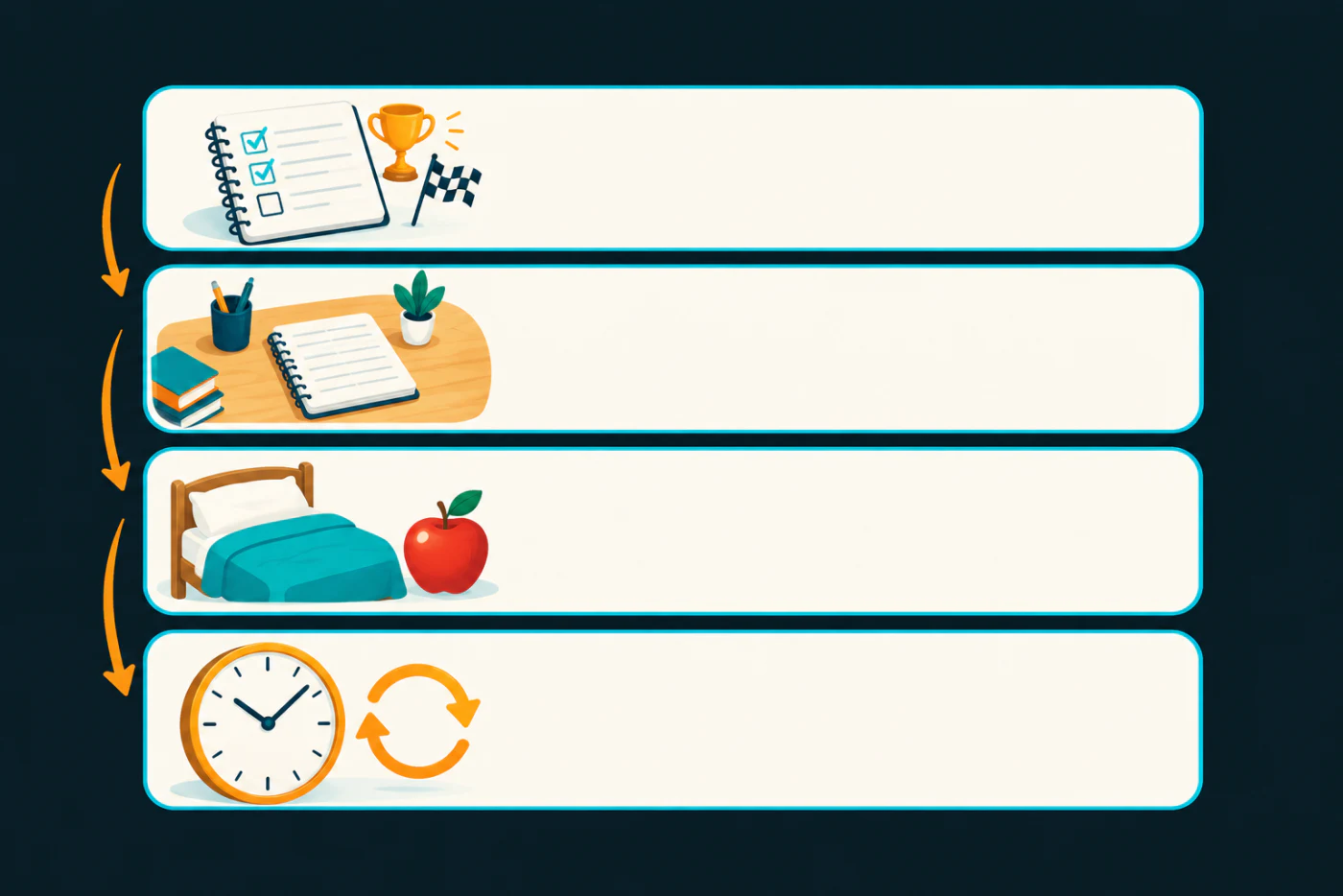 The task — one eveningThe place — one eveningThe body — a weekThe habit — a month
A plan for the week, one change at a time
The order is not arbitrary: the first three points are often enough and cost nothing. Each one says how you will know it worked.
- Measure how long they last today
An ordinary evening, a clock to one side, you change nothing. You write down two numbers: how many minutes passed before they first got up, and how many times they broke off in half an hour. Three such evenings are your baseline — without it, a month from now you will not know whether anything changed.
- Make the desk single-purpose
Ten minutes, once: only what the child is using right now stays on the desktop, the rest goes in a box — including the things that «don't bother anyone». How you will know: compare the first evening's measurement with the next day's.
- Take the phone out of the room
Not face down — into another room, for the length of one work portion. This is not about willpower; it is about leaving a notification nothing to interrupt. How you will know: in your own measurement from point one, the number of interruptions usually drops by the second day.
- Give the task a visible end
Instead of «study geography» — «three questions from this page». A 15-minute portion with the end visible from the start. How you will know: the child stops asking «how much longer», because they can see it.
- Check the time of day
Move studying an hour earlier for three days and compare the same measurement. It costs nothing but rearranging the day. For some children — especially those who sit down to homework straight after school — this is the only change needed.
- Write down what interrupted the work
A tally mark on a sheet at every interruption and one word for what it was. Three days. How you will know: if most of the marks are things from outside (a sibling, the phone, a question from the kitchen), you are fixing conditions. If they are «I thought about something else» — only then do you work on attention itself.
If the child holds attention nowhere, including on things they enjoy, and always has, that is an observation for a specialist, not material for rearranging a desk.
What it looks like in one evening
The same material — two pages of science revision — and the same time. The only difference is how the task is set.
An evening that falls apart
- The instruction is: «study science for tomorrow». How long it should take and when it ends — unknown.
- The child opens the notebook, reads the first paragraph, and after four minutes gets up for water.
- They come back, do not know where they were, and start from the top of the page.
- An hour later the notebook is open at the same page and the evening is over for everyone.
The same material in portions
- The instruction is: «five questions from this page, then a break». The end is visible from the first second.
- A 15-minute timer sits on the desk facing the child — not to hurry them, but so the end is visible.
- The phone is in another room; the desktop holds only the notebook and something to write with.
- After 15 minutes, a 5-minute break — planned, with movement, rather than taken once attention has already gone.
- The second portion: the same questions, but with the notebook closed, out loud.
Honestly: a portion with a visible end will not make the child like science. All it does is get the work started — and that is usually the step that was not happening.
Take this measurement this evening
Three minutes and a sheet of paper. This is not an attention exercise — it is the measurement everything else starts from.
- One ordinary task and a timer
Pick something the child has to do today anyway — not a test, not a game. Timer for 3 minutes, clock out of the child's sight.
- A tally mark for every drift
The child works while you sit beside them with the sheet. A mark every time they break off: get up, say something off-topic, reach for something, look out of the window. No comments and no reminders — today you only count.
- One word beside each mark
Write what it was: «brother», «phone», «thoughts», «boring». That is the real result of the measurement.
The number of marks means nothing on its own — what matters is what you wrote beside them. If things from outside dominate, start with the desk, the phone and the time of day: that is an evening's work, not a month. If «thoughts» and «boring» dominate, the conditions are already in order, and only then does working on attention itself make sense. Repeat the same measurement in a month on the same kind of task.
For comparison over time only a measurement taken the same way counts: the same time of day, a similar task, the same person counting. This is not a diagnosis and does not replace a consultation.
How long a work portion lasts at different ages
The numbers below are a starting point for your own measurement, not a norm. You start from what the child manages today and add two minutes at a time.
| Age | Where to start |
|---|---|
| 8–10 | A 10–15 minute portion, a 5-minute break with movement. The adult sets the task and breaks it up — at this age the child will not do that themselves. An adult sits at the desk, but stays quiet. |
| 11–13 | A 20–25 minute portion. The child splits the material into portions themselves; the parent checks the split at the start and the result at the end. This is usually where the phone first becomes a real competitor to studying — and where it is worth agreeing a rule before it becomes an argument. |
| 14–18 | A 25–40 minute portion. You set the rules together, or the teenager will reject them purely because of how they were imposed. The parent's role is the question «how is the plan going», not supervision at the desk. |
What the research says
Three papers that set what we promise and what we do not.
Rueda et al., 2005 — attention training in children
Short sessions of a few minutes of attention exercises produce a measurable effect in children. Hence our 10 minutes a day rather than an hour once a week.
Diamond and Ling, 2016 — a review of programmes targeting executive function
Attention and control improve where they are practised in real activity, and for as long as the practice lasts. That is why we work on school material and do not promise «better concentration in general».
Simons et al., 2016 — a review of «brain training» programmes
The evidence for brain-training programmes is weak, and improvement is usually confined to the trained task. So we do not promise better grades from platform training alone.
None of these papers studied Space Memory. One note about what is not in this text. The popular claim that the mere sight of a phone on the desk drains attention rests on a 2017 paper. Two attempts to replicate it, in 2021 and 2022, did not confirm the effect. So we write only what shows up in your own measurement: a phone in the room means interruptions that otherwise do not happen.
The most common parent mistakes with concentration
Five things that look like help and only make the evening longer.
«Concentrate» instead of changing the conditions
An instruction adds no attention. The only thing it adds is tension — and a tense child returns to the task more slowly.
Changing five things at once
A new desk, a new time, a new plan and rewards, all in one day. When something works you will not know what, and when nothing works, even less so.
Sitting beside them and correcting
Every remark from the side is an interruption, exactly like a notification. If you sit beside them, do it silently, and save the remarks for the end of the portion.
A break only once attention has gone
A break planned in advance is part of the work. A break taken after the child has fallen apart is just the end of studying.
Rewarding time at the desk
Then you are paying for sitting rather than for a portion done — and you get exactly what you paid for: an hour spent over one page.
How long each change takes to introduce
The real time from decision to visible effect.
| Stage | How long |
|---|---|
| The desk and the phone | One evening; the effect shows immediately |
| Task portions and the time of studying | A week to check and settle |
| The habit of a fixed time | About a month of daily repetition |
Measure attention instead of judging it
The free test is six short game-like tasks: memory, attention, speed and reasoning. It gives a reference point you can come back to after a month of changes.
Open the free testabout 15 minutes · no sign-up · instant result
Where this order comes from
From the first conversations with parents at Space Memory. Before a coach starts working on attention, they ask about the desk, the phone and the time of studying — because in a fair share of enquiries changing those three things is enough and no course is needed.
Questions parents ask
Can concentration be learned?
You can lengthen the time worked and shorten the return after an interruption — that is measurable. We are more careful with promises that a child will become focused on everything, because attention also depends on what they are being asked to do.
Does background music get in the way?
Music with words usually interferes with reading and writing, because it uses the same channel as text. Instrumental music is often neutral. Rather than take anyone's word for it, run the measurement from this page: three days with music and three without, on similar tasks.
How many breaks are acceptable?
As many as it takes to get back to work — a break is part of the work, not an interruption of it. What matters more is that it is planned, rather than the child getting up once attention has already gone.
Does sport help concentration?
Movement during the day helps in the sense that the child sleeps better and finds it easier to sit down. It is not a substitute for work on the task itself.
When are classes worth it?
When the conditions are already sorted and the work still falls apart after a few minutes. Then you work on attention itself rather than on the desk.
How long should a child this age be able to concentrate?
There is no single number to plug in: differences between children of the same age are larger than differences between year groups. A practical starting point is 10–15 minutes at 8–10 and 20–25 for a teenager, but the only thing that counts is how long your child manages today, measured on an ordinary task.
Do concentration apps and games work?
They improve your score in the game itself. Reviews of «brain training» programmes (Simons et al., 2016) show no transfer to schoolwork or grades. Attention improves where it is used — that is, on a real task from school.
What if the child concentrates only on what they enjoy?
That is useful information, not an excuse: the attention mechanism works. The problem is on the task side — its length, its clarity and its visible end. Start there before deciding it is a matter of character.
Three pages that develop the individual levers.
Concentration exercises for kids
Five exercises you can do at home
Would you like to work on attention with a coach?
Classes run 90 minutes once a week in groups of 5–10 children, with short 10-minute sessions in between. Leave a request and we will tell you about the next group.
Request a callThe guide is free. Classes add what home does not give — working alongside a group and someone who measures progress.