







The four areas that make up the profile
In a school conversation all four get boiled down to “able” or “not trying”.
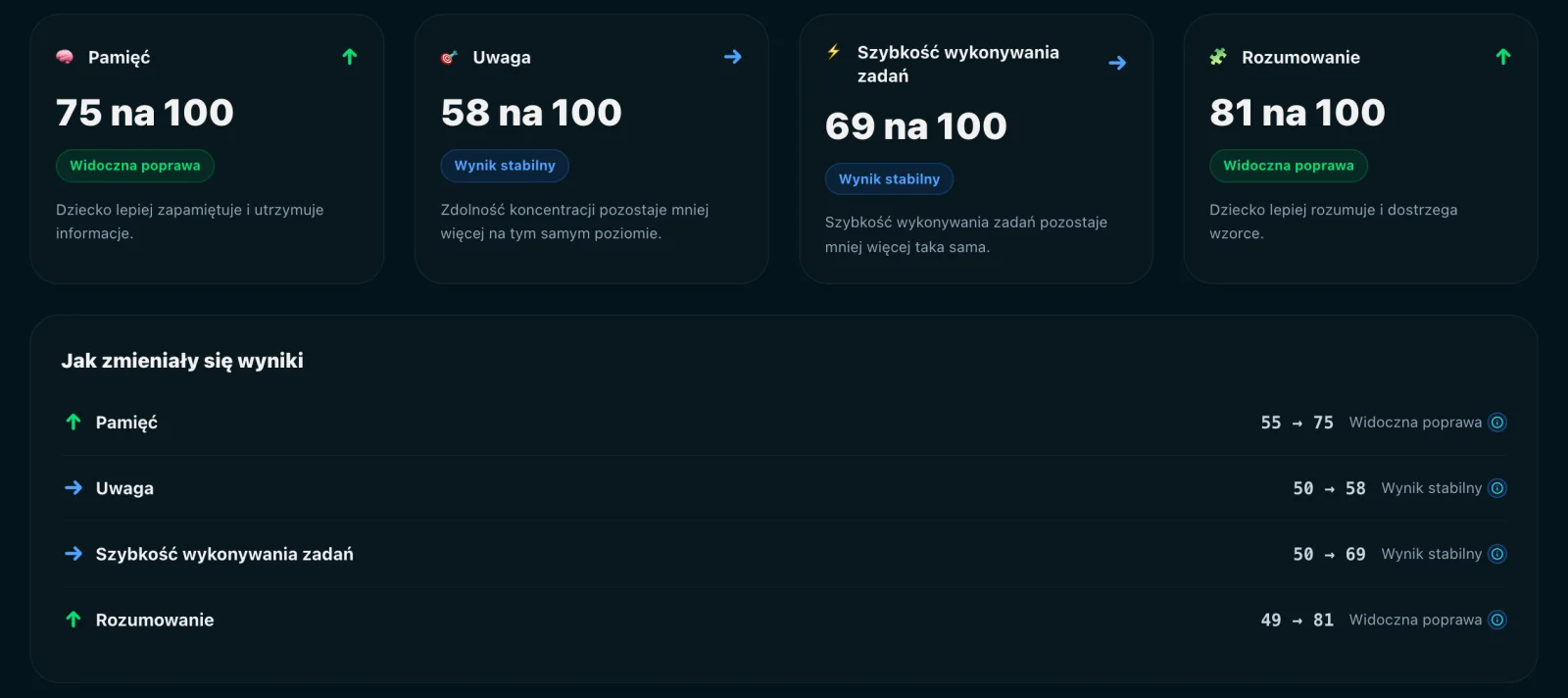
- Memory — How much the child holds at once, how they reproduce a spatial pattern, and how they cope with material that keeps changing. This is the backing of every lesson.
- Attention and inhibition — How long they hold a task, what the surroundings of a signal cost, and whether they can hold back an impulse. This is where “careless mistakes” come from.
- Speed and reasoning — How fast they respond and whether they catch the rule in a pattern they have not seen before. Speed without reasoning and reasoning without speed give quite different pictures.
What taking the test looks like
Six things worth knowing before you sit down to it.
- Six tasks, one after another
Each has a short instruction and a warm-up try. The child only starts once they know what to do.
- Difficulty matched to age
Once the age is entered, the tasks settle at the right level. So the age has to be the real one, not one “with room to spare”.
- A quarter of an hour in one go
Breaks in the middle change the conditions, and the result with them. Better to pick a moment when nobody will interrupt.
- An adult nearby, but quiet
Being there helps younger children; prompting spoils the measurement. The best place is a chair beside them, out of the child's line of sight.
- The result on screen straight away
No account, no waiting for a report by email. What you see at the end is the whole result.
- A repeat after a month or two
Only a second measurement shows a direction. With shorter gaps, practice at the tasks themselves starts to get in the way.
The result describes one sitting. A child who is short of sleep, unwell or upset will come out below their usual level — and that is not a flaw of the test but a feature of every measurement of behaviour.
What this test does not do
We say it plainly, because in the online test market this line often gets blurred.
It makes no diagnosis
No names of disorders, not in the result and not in our conversations. That is the area of specialists and other procedures.
It does not measure intelligence
There is no IQ figure here and nothing that could be converted into one.
It does not replace school or a consultation
It is a starting point for a conversation with the class teacher or a specialist, not a substitute for one.
It does not predict the child's future
Today's profile says nothing about how the child will cope in five years: cognitive functions change along with them.
Who it is for and how often
The practical limits of use.
| Stage | How long |
|---|---|
| Age | 6–17, difficulty matched to the age given |
| Time | The short version about 7 minutes, the full one about a quarter of an hour |
| Repeat | No more than once every month or two |
Take the test now
The short version is three game-like tasks and three areas in the result, with no sign-up and no card details. The full one is six tasks, four areas, and a profile saved to an account.
Open the free testshort test, about 7 minutes · no sign-up · result right away
Who is behind it
The test was built at Space Memory, a family school that teaches children aged 8–18 how to remember and how to work with material. The tasks rest on classic paradigms from cognitive psychology and are built on jsPsych, an open library used in scientific research.
Parents' questions
What does “cognitive test” mean?
These are tasks that check the processes a person learns with: memory, attention, speed and reasoning. Unlike a school test they need no school knowledge, so the result does not depend on whether the child has caught up.
How is it different from an assessment by a specialist?
In scope and in the weight of its conclusions. A specialist runs a full procedure with an interview and diagnostic instruments. Our test is a short overview that shows whether there is anything to discuss.
Can the result be printed for the teacher?
The result screen can be shown or saved to a file. It is not a document for the school, though, and should not be presented as one.
My child is 5 — can they try?
The tasks are made from age 6. A younger child will get through them technically, but the result will mostly say how they understood the instructions.
Does anything need installing?
No, the test runs in a browser. A computer or tablet is more comfortable than a phone.
Why does a memory school have its own test?
To start from a number rather than an impression. The same test a month or two later shows whether the work changed anything. Without it, only opinions are left.
Pages: the separate parts of the test and the tools it rests on.
Memory test for kids online
Three memory tasks and how to read them
Attention test for kids
Holding attention, distractors, inhibition
Space Memory cognitive tests
Which tasks we use and where they come from
You have a result and the question “what now”?
In online classes we work on the way of studying and on memory: 90 minutes once a week, in a group of 5–10 children. We also arrange a free trial lesson, to see whether this is the right direction.
Request a callThe test is free. It makes no diagnosis, does not measure intelligence, and does not replace a specialist's consultation.