






Three marks of a task that means something
This is what separates a research procedure from a game labelled “IQ test”.
- It has a history of use — A paradigm described in the literature and used for years can be compared across studies. A task invented for one app compares with nothing.
- It measures one thing at a time — A good task is built so the result depends mainly on the ability under study, not on reading, school knowledge or nimble fingers.
- It has a built-in reliability check — Random clicking, guessing and answers that come too fast can be detected. Without that, a result can describe a mood rather than an ability.
Six tasks and what each measures
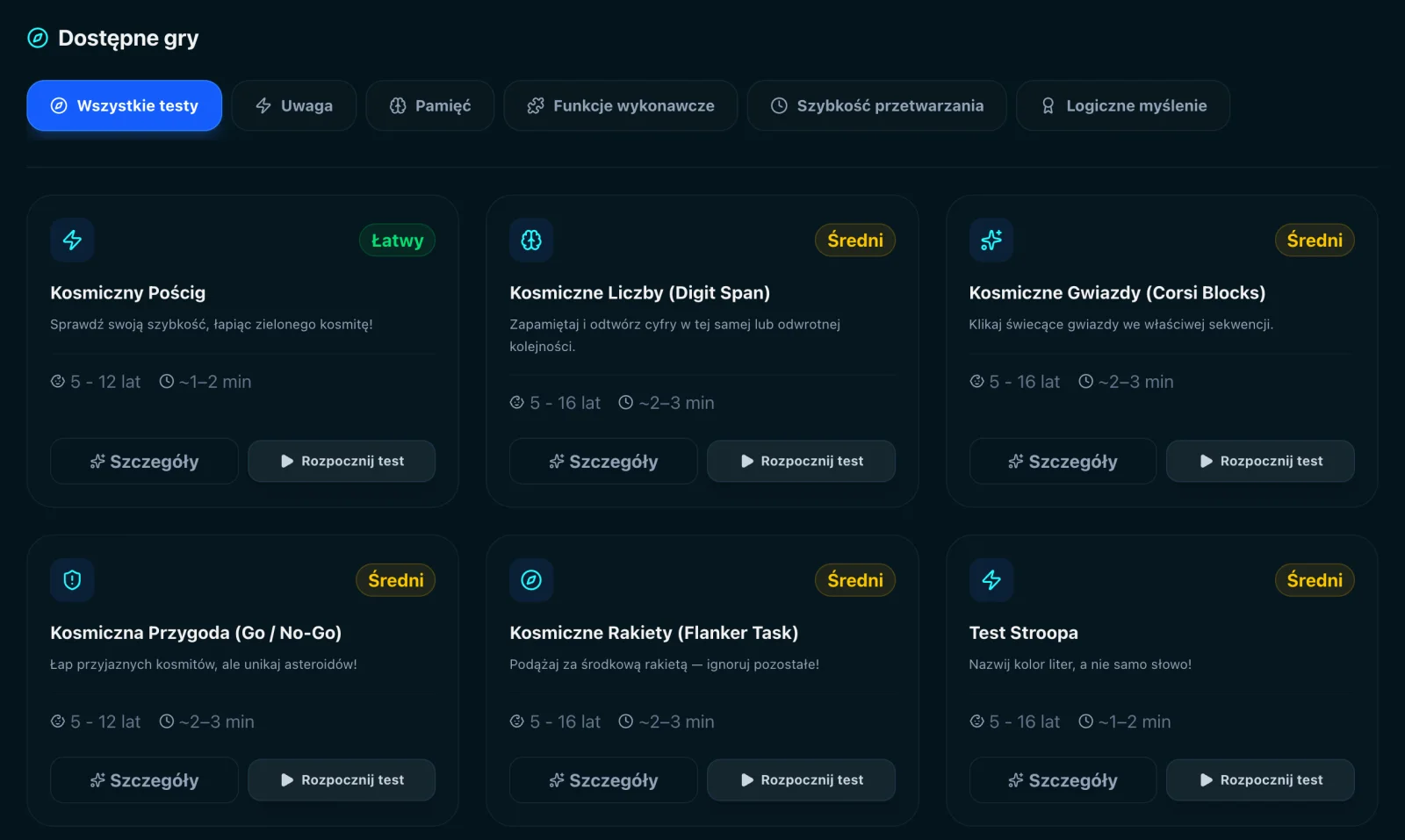
We give the names of the paradigms on purpose — you can look them up away from our site. Beyond the screening itself, the app catalogue now holds sixteen tasks, with more in preparation.
- Digit span
Repeating a string of digits in order and from the end. The forward version speaks about the capacity of immediate memory; the backward one about working memory, because the material has to be transformed.
- Corsi — reproducing a pattern of points
Squares light up in a set order and are repeated after the display. It is the digit span's counterpart for visual-spatial memory.
- Reaction time
A short task about pure speed: the signal appears at an unpredictable moment, and what counts is the time between it and the key press. It gives a reference point for the other tasks, where reaction time is mixed in with thinking.
- Sustained attention (CPT)
A long series of stimuli where a rare signal calls for a response and the rest do not. What counts is not speed but vigilance to the end: misses late in the series show how long the child holds attention.
- Flanker
A signal surrounded by matching or misleading elements. The time difference between those versions shows what cutting off the surroundings costs.
- Matrices
The child works out the rule in a pattern they have not seen before, with no school knowledge involved. It is the longest task in the set, and it usually shows how much energy is left at the end.
Our versions are shortened and adapted for a child at a screen at home. That means they are modelled on these paradigms, not identical to the standardised instruments used in a consulting room. Two paradigms sit outside the free screening: go/no-go, in the short seven-minute mission, and n-back, in the Brain Memory test for teenagers from twelve.
What it rests on and where the limits are
Four things we would rather say ourselves.
The open jsPsych library
The task engine is jsPsych under the MIT licence, a tool used in psychological research to run experiments in a browser.
No population norms
We do not show how a child does “against their peers”. A sound norm needs a large, representative sample — until then we compare a child with themselves.
Change, not a single result
The difference between two measurements has to be told apart from ordinary fluctuation. That is why we advise a repeat after a month, not after a week.
The limit of our claims
We do not call this a diagnosis, we do not compute an IQ, and we do not comment on disorders. We hold to that rule in conversations with parents too.
What we can say and what we cannot
Three levels of conclusion, so there is no confusion.
| Level of conclusion | What it means |
|---|---|
| We can | Which areas came out higher and which lower for this child |
| With care | Change between measurements — only on a repeat and in similar conditions |
| We cannot | A diagnosis, an IQ figure, a forecast for school |
See it for yourself
The short version — three tasks — is free and needs no account. The simplest way to judge the tool is to take it yourself.
Open the free testshort test, about 7 minutes · no sign-up · result right away
Why a school has its own tool
Space Memory teaches memory techniques and ways of working with material. Without a measurement at the start and one later, only opinions are left: the parent's, the teacher's and our coach's. The test is there so that conversation also has a number in it — with a clear sense of how much such a number means, and how much it does not.
Questions
Does Space Memory use the Gibson test?
No. The Gibson Test of Cognitive Skills is a commercial instrument of the American LearningRx network; we have no connection with it and do not administer it. Our tasks are modelled on the paradigms described above.
Is this an IQ test?
No. We do not compute an IQ and do not convert the result to any scale of that kind.
Who developed the tasks?
The Space Memory team, on the basis of publicly described paradigms and using the open jsPsych library. The graphics and the matching of difficulty to age are ours.
Why is there no comparison with peers?
Because we have no norms of our own collected for a child population. Showing percentiles without that basis would be a promise we could not back.
Can the results be used by a specialist or at school?
As material for a conversation, yes. As a diagnostic document, no; specialists run their own procedures with their own instruments.
Is the test available in other languages?
Yes, the interface exists in several language versions. The tasks are mostly non-verbal, so language mainly affects the instructions.
Pages: the test itself and what we do after it.
Cognitive test for kids
The whole profile in a quarter of an hour, for parents
The Space Memory method
What we teach after the test, and how
Results and measurement
What we measure in class and how
Want to see what we do with the result?
In online classes the coach starts from where studying breaks down and works on it with a group of 5–10 children, 90 minutes a week. The manager will tell you the terms and the timetable of the next group.
Request a callThe test is free and open to everyone. It is not a clinical instrument.