








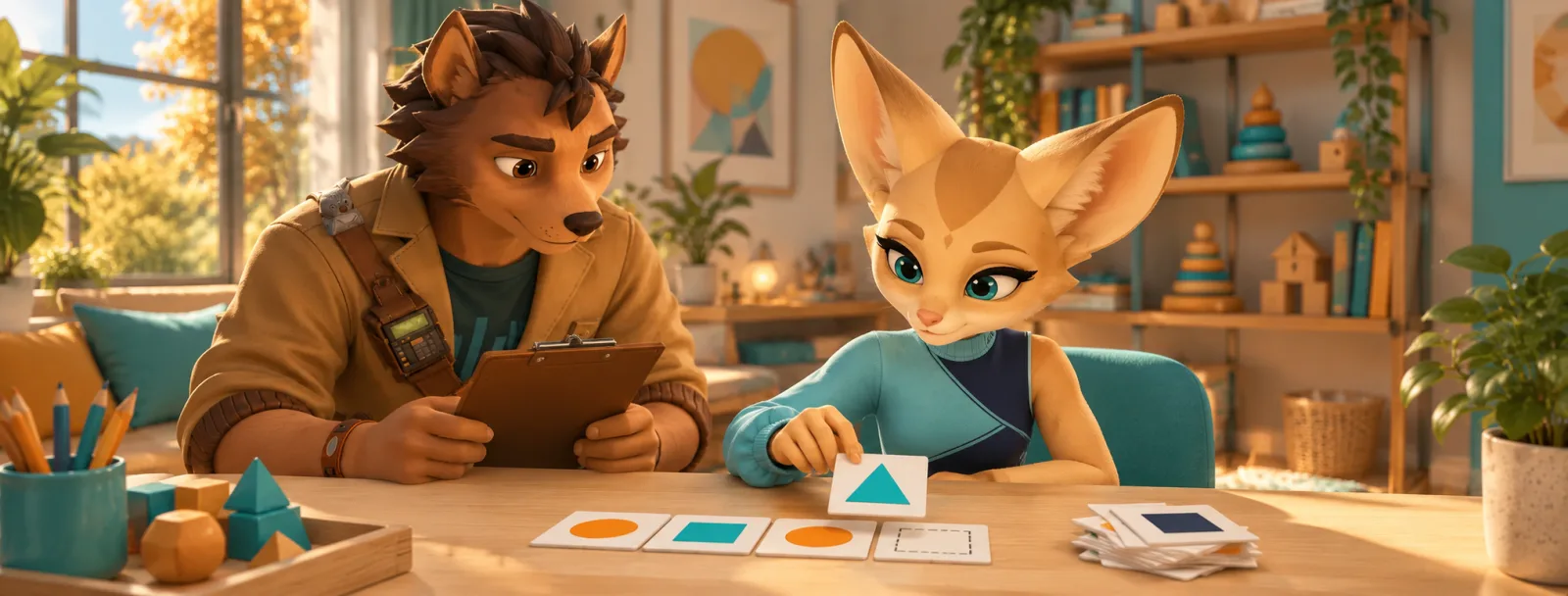
Three things it gets confused with
Telling them apart takes a minute and saves months of misunderstanding.
- It is not a test of knowledge — It does not ask about dates, formulas or set texts. A child who has missed half a term can do well — and equally, the top of the class does not necessarily come out highest.
- It is not an intelligence test — Intelligence tests are a separate group of instruments, administered by qualified specialists and ending in a score on a defined scale. Short online tasks are not that, even when they advertise themselves as such.
- It is not a diagnosis — A conclusion about learning difficulties comes from an assessment service or a doctor, based on an interview, observation and instruments that cannot be filled in inside a browser in a quarter of an hour.
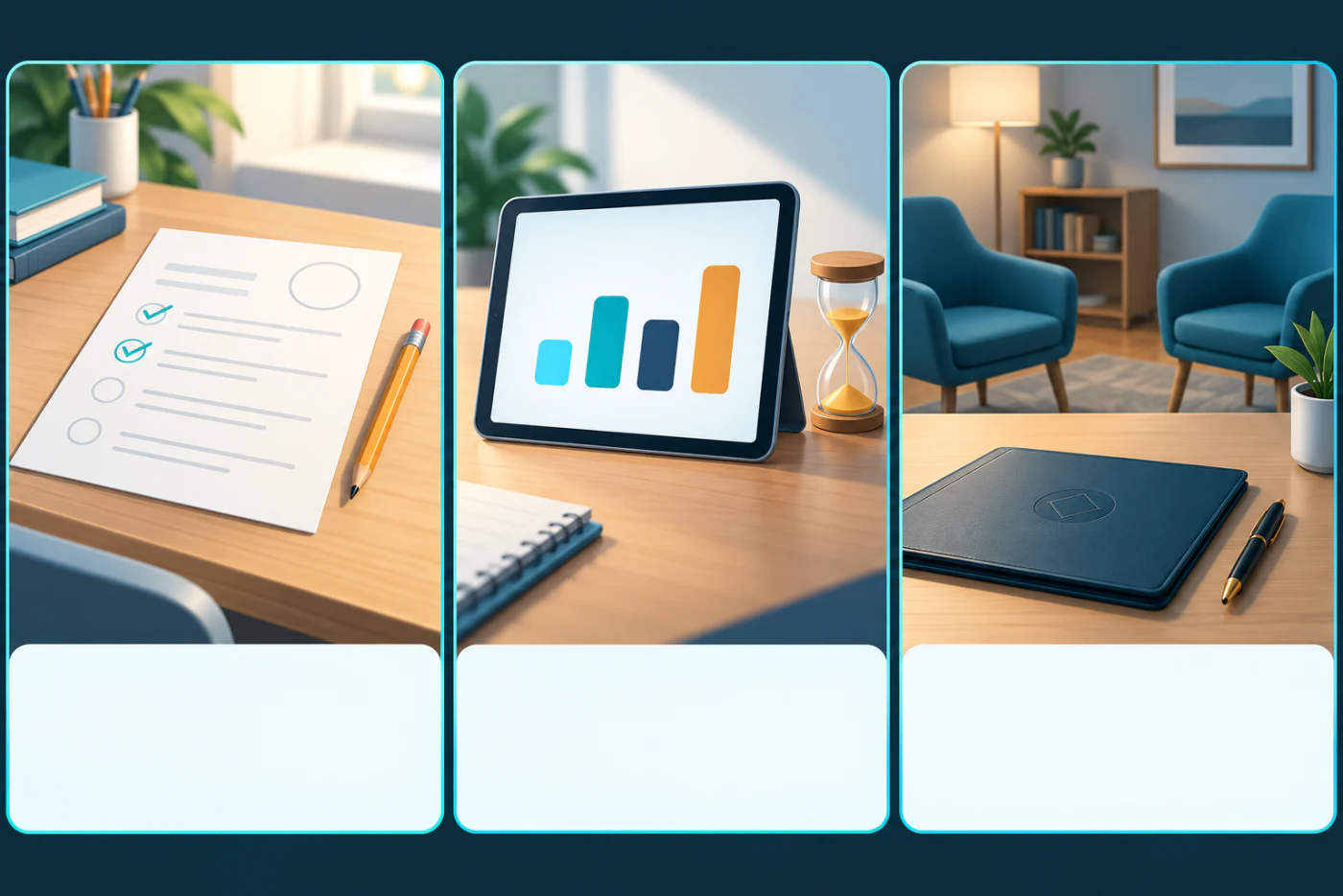 School test — how much they knowScreening — anything to discussAssessment — a specialist's report
What such a test checks in practice
Six things that usually make up a profile. Each corresponds to a different trouble in the classroom.
Memory span
How many items the child holds at once. A low score usually sits behind multi-step instructions getting lost.
Working memory
Holding material and doing something with it at the same time. This is what gives out on word problems.
Sustained attention
How long the child stays with a task where nothing interesting happens. This is where skipped questions at the end of a quiz come from.
Inhibition
Whether they can hold back when an answer suggests itself. It is separate from attention and is worked on differently.
Processing speed
How quickly they respond to a simple signal. A low pace alongside a good profile looks in school like “did not finish”, not like “did not know”.
Reasoning
Spotting the rule in an arrangement they have not seen before — with no school knowledge involved and no reading.
What to do before the test and after it
Five things that decide whether the result will mean anything at all. For each: how long it takes and how you will know you did it properly.
- Choose the time of day, not the moment
Not after training, not late in the evening, not on the day of a school test. A weekend morning is best. It takes no minutes at all, because it is only a choice of day. How you will know: the child is not yawning on the first task.
- Read the instructions together, out loud
Two minutes. Most low scores among younger children come from a misunderstood instruction rather than from the task itself. How you will know: the child can say in their own words what they are about to do.
- Leave the child alone, but stay within reach
A quiet room, a closed door, the phone out of the room — for a quarter of an hour. How you will know: nobody came in and nobody prompted during the whole thing. One prompt invalidates any comparison with the next measurement.
- Write the conditions down with the result
One sentence: date, time of day, how the child slept, what happened that day. Half a minute. How you will know: in three months you will know whether you are comparing like with like.
- Before drawing a conclusion, look for the same thing at school
A week of watching and one conversation with the class teacher. How you will know: you can describe a specific situation from a lesson, not just a bar on a chart. Only then does a conversation with a specialist have somewhere to start.
The result alone does not say why something came out lower. The cause can be tiredness, stress, too little sleep or a misunderstood instruction — and that has to be ruled out before anything gets planned.
How to read a result — one example profile
The example is invented for this text, to show the way of reading. The same set of numbers can be read well or badly.
How a parent usually reads it
- “Processing speed lower than the rest” — that is, the child is slower than others.
- “There must be some disorder, since one bar sticks out.”
- Conclusion: that bar needs training, ideally with an app that trains it.
- That is where the use of the result ends — and where unnecessary worry usually begins.
What actually follows from it
- One lower score is not a diagnosis but a place worth asking about.
- First rule out the simple things: had the child slept, what time they took the test, whether they understood the instruction, whether anyone came into the room.
- Then look for the same thing at school: if the pace is lower, in class it looks like “did not finish in time” rather than “did not know” — and those are two different conversations with a teacher.
- Only when the same thing shows at home, at school and in the result is it worth taking to an assessment service.
- The result itself is the beginning of a conversation, not the end of one.
Numbers and bars with no description of what exactly was measured and against whom are decoration. If a tool does not say that plainly, the result is no use for any of the steps above.
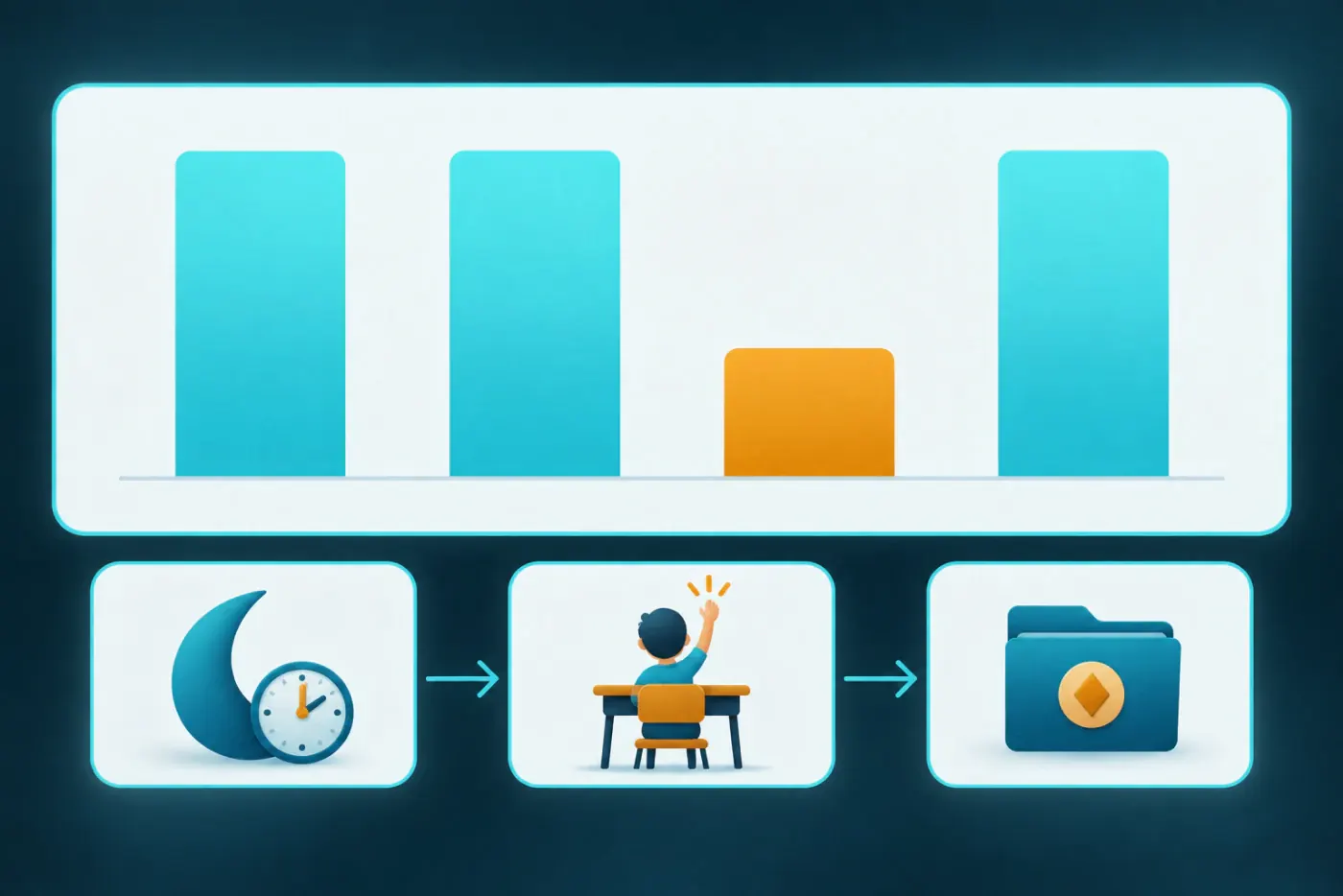 Profile: one area lowerSleep, timing, instructionThe same at school?Only then an assessment
What such a task looks like — try it on yourselves
Two minutes and no equipment. This is not a measurement of the child — it is a demonstration of how a cognitive task differs from a test of knowledge.
- Repeating digits — forwards
Read five digits aloud to the child at one a second, for instance 7 · 2 · 9 · 4 · 1. The child repeats them in the same order. If that worked, add a sixth and read out a new set.
- Repeating digits — backwards
The same arrangement, but the child repeats from the end. Start with three digits. This is already a different task: you have to hold the digits and do something with them at the same time.
- Notice the difference between the two
For almost everyone, backwards comes out two or three digits shorter than forwards. That is not an error or a sign of anything — it is precisely the difference between holding and processing.
The outcome is not the number of digits but an understanding of what such a task checks at all: not knowledge, not preparation, not diligence — the way the head is working at this moment. That is why you cannot study for a cognitive test, and why the result depends on sleep and time of day more than anyone expects.
This is not the test or a short version of it. Real digit-span repetition is part of standardised instruments with an established procedure and norms — and a task done at a kitchen table has neither.
What the research says
Two papers explaining where the fourth warning sign comes from — the one about a result leading straight to a purchase.
Simons et al., 2016 — a review of “brain training” programmes
The team went through the evidence cited by companies selling cognitive training. The conclusion: the evidence is weak, and improvement usually applies to the trained task itself rather than to studying or work.
Melby-Lervåg and Hulme, 2013 — a meta-analysis of working-memory training
Working-memory exercises improve performance on the exercises themselves and do not transfer to marks or to reading. So a low bar in a screening is not a reason to buy a subscription to training that bar.
Our free test is also a tool belonging to a school that sells classes — which is why we describe its limits in the same text that mentions it.
Four warning signs
They tell you which online test's result is better ignored.
It promises a diagnosis
Any tool that names a disorder after a quarter of an hour in a browser crosses a line that must not be crossed.
It gives an IQ figure
An IQ score from a short online test has no backing in the procedure such scales are built on.
It shows percentiles without explanation
A comparison “with peers” requires a collected, representative sample. If nowhere does it say where the norm came from, the number is decoration.
The result leads straight to a purchase
When a low score immediately turns into a subscription offer, the measurement stops being a measurement and becomes part of the sale.
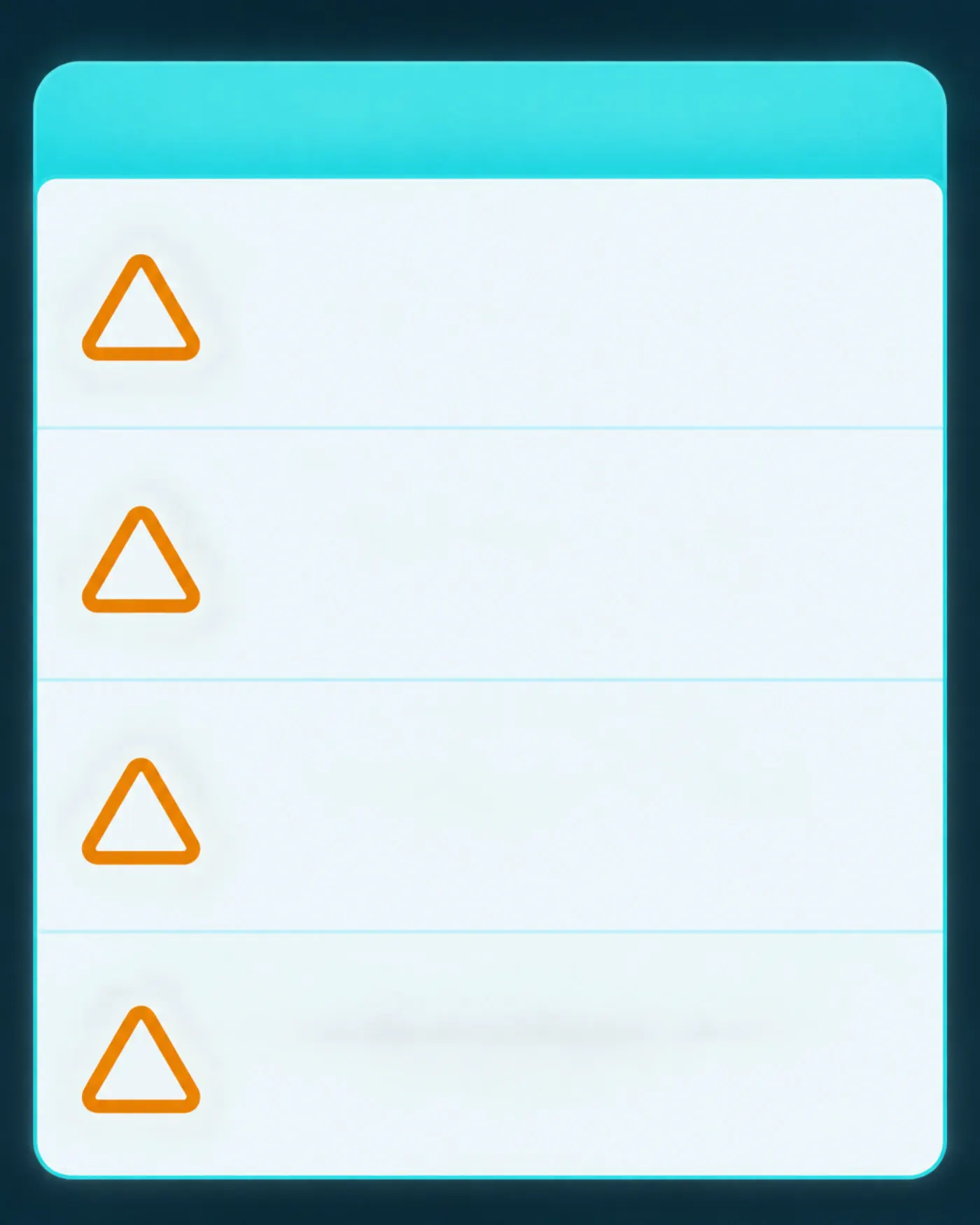 Warning signsIt promises a diagnosisIt gives an IQ figurePercentiles with no source for the normThe result leads straight to a purchase
The most common mistakes when reading a result
Five things that turn a sensible screening into trouble.
Treating the result as a diagnosis
A screening says whether there is anything to discuss. A diagnosis comes from an assessment service or a doctor — and from several sessions, not a quarter of an hour.
Comparing with a sibling
Two profiles are never the same, and there is no information in that about who is “brighter”. The only sensible comparison is the same child a few months later.
Doing the test at the wrong moment
Late evening, after training, on the day of a school test. A result from a day like that says something about tiredness, not about the child.
Showing the child the result like a mark
“You have a bad memory” stays for years and works as a label. If you are going to talk about the result, talk about what it means for studying, not about what the score was.
Repeating the test every week
At short intervals what grows is familiarity with the tasks, not ability. Coming back makes sense after a few months.
Two different things under one name
It is worth knowing which one the person you are talking to means.
| Stage | How long |
|---|---|
| A short screening | Fifteen minutes or so, online, answers: is there anything to discuss |
| A full assessment | An assessment service or a specialist's office, several sessions, ends in a report |
| What neither of them does | Neither predicts how the child will be doing in five years |
See what a short screening looks like
Our free cognitive test is exactly that first version: three game-like tasks, three areas in the result, no diagnoses and no IQ. The full version is six tasks and four areas, after signing up.
Open the free testshort test, about 7 minutes · no sign-up · instant result
Why we write about the limits
Because we run such a test ourselves, and the easiest thing would be not to describe it precisely. A parent who knows this is a screening rather than an assessment will put the result to proper use: as the beginning of a conversation, not as a verdict about their child.
Parents' questions
Can you prepare for a cognitive test?
Not in the sense of learning material — there is no school knowledge in it. Sleep, time of day and quiet in the room do affect it, so those three are worth arranging.
Can the score get worse on a repeat?
Yes, and that is normal. A worse day, tiredness or boredom with familiar tasks can lower the result with no change in the child at all.
Will school accept such a result?
As material for a conversation with the class teacher, usually yes. As grounds for formal adjustments, no; that needs a report from an assessment service.
From what age does a cognitive test make sense?
Short online tasks usually from the age of six. With younger children the result mostly says how well they understood the instruction.
Will the test detect dyslexia or ADHD?
No. Those are diagnoses made through defined procedures involving an interview and information from school. At most a test can show a picture worth taking to someone.
What does an assessment cost?
That depends on the country and the service. Where public assessment services exist, the assessment is normally free and a parent or guardian applies for it directly.
Is a low score in one area a reason to worry?
Not in itself. A profile with one lower area is more common than an even one — what matters is whether the same thing shows up at school and at home. If it shows in three places at once, it is worth booking an assessment.
Does a cognitive test result predict marks?
Not at the level of an individual child. It shows where studying costs more effort, not what the report card will say — that also depends on the way of studying, on home and on the subject itself.
Pages on checking at home and on what to do with the result.
Cognitive test for kids
A free screening: memory, attention, speed and reasoning in one place.
Developmental classes for kids online
Which course for which difficulty — memory, attention, reading or study skills.
How to check a child's memory
Home memory tries and what must not be read into them.
How to improve memory for kids
What to do when the profile pointed at memory.
How to improve a child's concentration
The same, when attention came out lower.
You know what to look for — what next?
If the result shows that the issue is the way of studying, that is what we work on: 90 minutes once a week, in a group of 5–10 children. Leave a request and we will tell you about the next group.
Request a callThis text explains the terms. It is not diagnostic advice and not an invitation to make diagnoses at home.