







What this page does not claim
We start with a caveat, because the subject of strengths in education has been trampled by one popular theory.
- These are not “learning styles” — The popular theory says a visual child learns better when material is presented visually. Reviews of the research do not bear that out, and we write about it below, in the section on research.
- A strength is not a label — “You are a visual learner” closes doors instead of opening them. We are talking about what comes more easily to a child this year, not about who they are.
- This is not guidance for choosing a career — Two weeks of watching says something about how to work on homework, and only that.
Why it is worth knowing the strength
Three things that change the moment you stop guessing.
Studying stops being a fight with the material
The same topic worked through in a way the child handles more confidently is often shorter — but whether that is so for your child is told by your own measurement, not by a type. The research does not support the idea that matching the form of presentation to a “type” improves results by itself. This is not making things easier — it is choosing the tool.
The weaker side gets a prop
A child with good visual memory and weak auditory memory does not have to hold instructions by ear — they can write them down. Working around is cheaper than training everything.
The conversation at home changes tone
Instead of “you were not paying attention again” comes “this goes in through drawing for you, let us try it that way”. The difference in willingness is often bigger than the difference in method.
Two weeks of watching, six things to notice
Note one sentence a day. After fourteen days the picture assembles itself.
- What they remember without effort
Routes and the arrangement of a room, tunes and lines from films, or rather numbers and the rules of a game. The first thing worth writing down, because it shows every day.
- How they tell you about events
In images and scenes, in dialogue, or in order from cause to effect. How they tell a story gives away how they organise.
- What they do when nobody tells them to
Draw, build, arrange, talk, take things apart. This is the most honest sample, because there is no marking in it.
- What makes them understand something new fastest
Being shown, being told, or trying it themselves. Test it on something neutral: a new board game, a recipe, assembling furniture.
- When they tire fastest
While listening, while looking, while sitting still. Where the tiredness appears points to the weaker channel as well as any test.
- What the teacher says apart from marks
One question at a parents' evening: what is the child good at. The answer is often surprisingly specific if you ask outright.
This is not a division into “types of learner” and it does not work as a permanent label. Strengths shift with age, and most children use several channels at once.
The same topic, three different routes
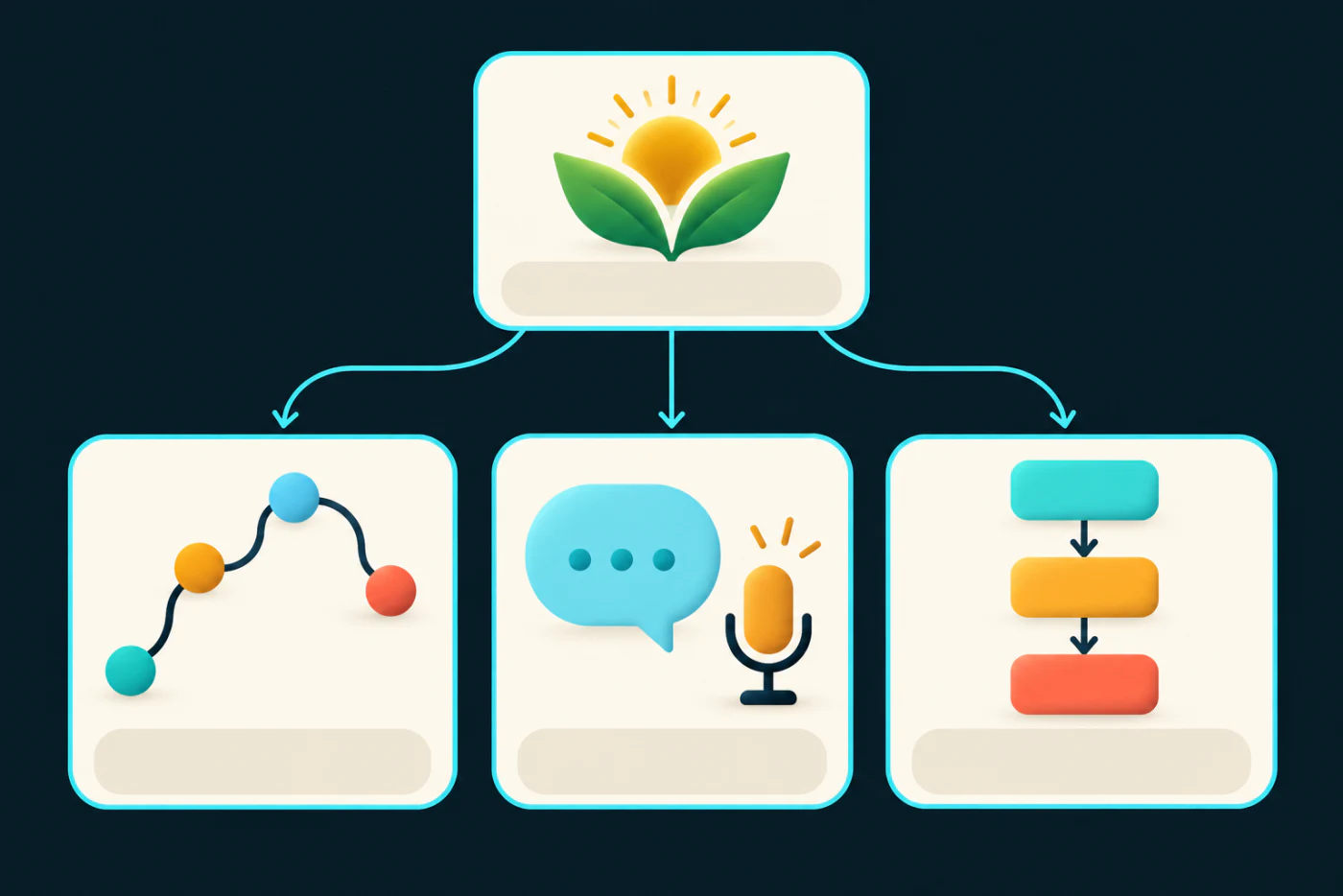
The stages of photosynthesis to be memorised. Three children, the same material, three ways of working — matched not to a “type” but to what actually works for each of them.
The route everyone takes
- All three children read the chapter and copy the definition into their exercise books.
- Two remember the order, one does not — and is told to “read it again”.
- After the third reading they still do not remember, and at home the conclusion settles that they “have no memory for biology”.
Three routes to the same place
- The child who effortlessly remembers the layout of a room and routes: draws a diagram of the stages and lays them out as a route around the kitchen.
- The child who repeats film lines and tunes: tells the stages aloud, records themselves on a phone and listens back once in the evening.
- The child who looks for rules and organises: derives the order from the sense of the process — what has to come first for the next thing to have anything to come from — and memorises nothing by heart.
- The material is the same, the time is similar and the route is different — and that is the whole practical content of the phrase “a strength”.
The point that separates this from learning styles: we are not claiming the third child cannot memorise an order. We are claiming they have a way that is cheaper for them — and that it is worth knowing before telling them to read the same thing a third time.
 One piece of materialDrawing and routeTelling it aloudRule and derivation
One question over two weeks
Watching rather than a test. All you need is one sheet on the fridge and one question you answer in a single word each day.
- Write the question: what stuck today with no effort
Anything: the way to a new friend's house, the words of a song, the layout of cards in a game, a scoring rule.
- One word a day, for fourteen days
No analysis. Writing it takes ten seconds.
- After two weeks read the list all at once
Only now do you look for repeats: do routes and layouts dominate, or sounds and conversations, or rules and numbers.
- Test one thing in practice
Take the next thing that has to be memorised and present it by whichever route came up most often. Compare with how long it usually takes.
The outcome is not a type of child but one practical pointer for the coming month: where to start when the material is new. If the list shows no pattern, that is a result too — it means the child copes differently depending on the material, and then you choose the technique to fit the material rather than the child.
Do not tell the child you are checking their strengths. Watching that is known about changes what is being watched — and besides, it turns into a label all too easily.
What the research says
One paper worth knowing before anyone tells you your child is a visual learner.
Pashler, McDaniel, Rohrer and Bjork, 2008 — “Learning Styles: Concepts and Evidence”
A review of the evidence for the popular learning-styles theory. The authors found very few studies designed in a way that could test it at all, and the few that were did not confirm that matching the form of presentation to a declared “style” improves learning.
That is why this page has no test for a child's type and no sentence saying “visual learners learn visually”. It has something narrower and checkable in your own home: noticing what specifically comes more easily to this child this year — and testing whether presenting material that way shortens the work. If it does not, the conclusion is that it was not a strength.
What to do with a strength
Four examples of turning an observation into an evening of homework.
Strong visual memory
Material through a drawing, a mind map and a route around a familiar place. Dates and sequences turned into scenes rather than lists.
Strong auditory memory
Telling it aloud, recording themselves and listening back, rhymes for rules. A note with questions read half aloud.
Strong reasoning from rules
Deriving rather than memorising, looking for the pattern in the material, organising into tables. Such a child copes badly with cramming that makes no sense.
A need for movement and doing
Studying standing up, walking while reviewing, cards laid out around the room. Forced sitting eats half the attention of a child like this.
What the test adds
Watching and tasks answer different questions — together they give a fuller picture.
| Source | What question it answers |
|---|---|
| Watching at home | How the child works in real situations |
| Test tasks | How they work without the help of context and habit |
| A discrepancy between the two | The most interesting information — usually about the conditions, not the child |
Add a short test to the watching
The free cognitive test shows three areas: memory, attention and reasoning. After seven minutes you can see which of them comes out higher for your child.
Open the free testshort test, about 7 minutes · no sign-up · instant result
Why we need this in class
A Space Memory coach matches the first techniques to what suits the child: with a strong imagination they start with images; with strong rule-based thinking, with grouping and structure. That is why the first session is largely about how the child works rather than about how much they remember.
Parents' questions
Is this not the discredited learning-styles theory?
Not in the “a visual child should only be taught visually” version — that really does not hold up. This is something narrower: noticing what comes out better for a child and using it as a prop rather than as the only channel.
Can a strength change?
Yes, and it changes with age and experience. So the watching is worth repeating a year later rather than treating the conclusion as fixed.
What if no area comes out clearly higher?
That is a common and perfectly normal picture — it just means there is no one obvious lever. Then you choose the technique to fit the material rather than the child.
Should we tell the child what came out?
Yes, in descriptive form: “you remember layouts quickly” rather than “you are a visual learner”. The first is an observation, the second a label.
Does this help with choosing a school or a career?
Not in that sense. A cognitive profile says something about how someone works, not about career aptitude — those are different instruments and different procedures.
Do the weaker sides need training?
Some do, some are easier to work around. Working-memory capacity grows slowly, while writing an instruction on a piece of paper works from tomorrow.
Pages on the test itself, reading it and what to do next.
Cognitive test for kids
A free screening: memory, attention, speed and reasoning in one place.
Developmental classes for kids online
Which course for which difficulty — memory, attention, reading or study skills.
What is a cognitive test
What it shows and what it does not
Memorising techniques for kids
Matching the technique to the material and to the child
How to study effectively
The order in which studying gets sorted out
Would you like someone else to match the techniques to your child?
In online classes the coach starts from how the child works and chooses the first techniques from that: 90 minutes once a week, in a group of 5–10. Leave a request and we will tell you about the next group.
Request a callThe watching and the test are free. They are not for labelling a child or for choosing their career.