








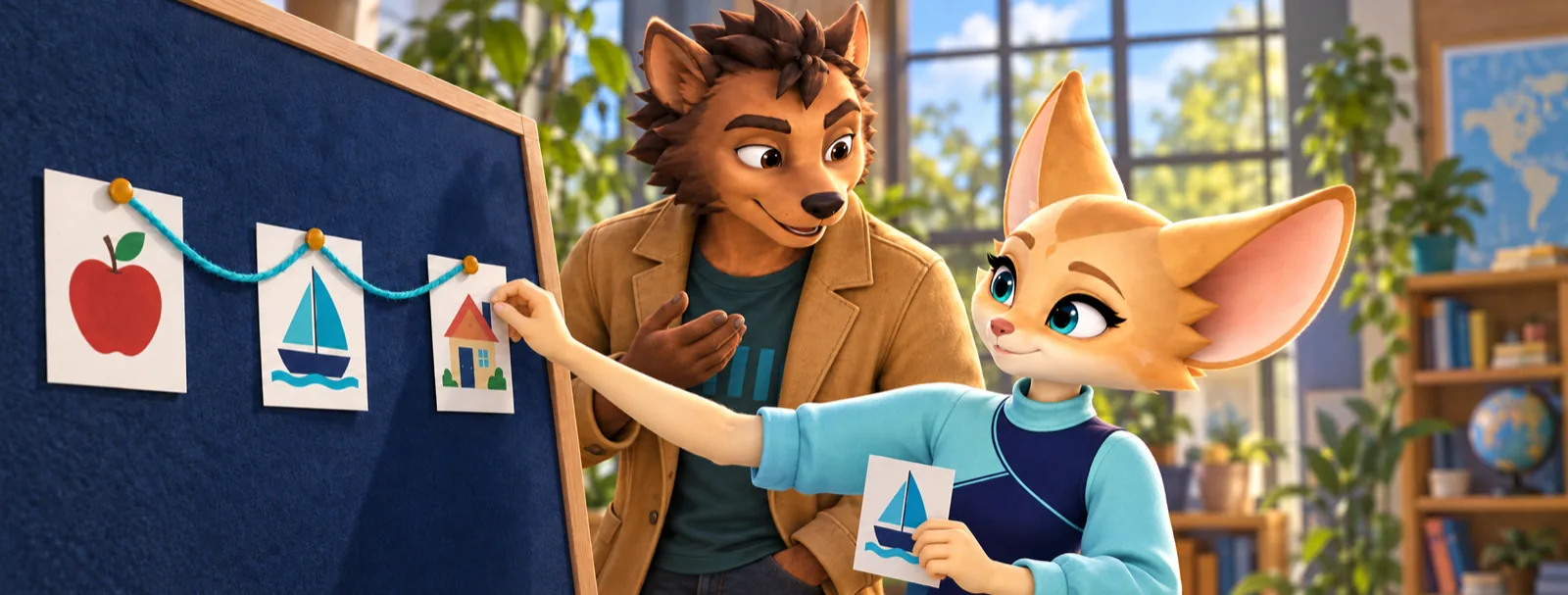
Why cramming stops working
In the early years repeating a few times is enough. From about the age of ten there is simply too much material for that.
- Too much material — Several subjects a day, each with its own dates and terms. Repeating until it sticks no longer fits in the day.
- Nothing to hold on to — Memorised text has no handle. A mnemonic gives an image the memory can come back to.
- Boredom — Cramming is grim, so the child postpones studying. Turning material into images and stories is simply more interesting.
The four techniques we start with
Each has its own use — together they cover almost all school material.
An image
Turning a word, a number or a concept into a distinct, concrete image. The foundation of every other technique.
An association
Linking the new to what the child already knows — ideally odd and moving, because that is what stays.
A chain
Images joined into one story: each follows from the last, so the order comes back on its own.
A memory palace
A familiar place with a fixed order of stops — one piece of information at each. For longer lists and for speaking.
Mnemonic examples — ten patterns for school lists
Each example comes with how it is built. Show your child the pattern, then let them make their own — their own always sticks better.
- Spelling tricks
BECAUSE: “Big Elephants Can Always Understand Small Elephants”. The words carry the tricky letters in order. A sentence the child invents for their own problem word works even better than this classic.
- Colours of the rainbow
Red, orange, yellow, green, blue, indigo, violet: “Richard Of York Gave Battle In Vain”, or simply the name ROY G. BIV. Same condition: the child's own sentence, and the sillier the better.
- Times tables: 56 = 7 × 8
The digits run in order — 5, 6, 7, 8: “fifty-six is seven times eight”. The hardest facts become short patterns or scenes with number images — and stop being strings of digits.
- A difficult foreign word
Polish “pies” means dog and is spelt exactly like the English “pies”. Scene: a dog stealing pies from a windowsill. The sound gives the hook, the scene links it to the meaning — handy for children learning Polish at school.
- How many days in a month — knuckles
Make two fists and count from the left: a knuckle is a 31-day month, the dip between knuckles a shorter one. January on a knuckle, February in a dip, March on a knuckle; July and August land on two knuckles side by side as you move from one hand to the other.
- Compass points, clockwise
North, East, South, West: “Never Eat Shredded Wheat”. Read it while tracing the compass with a finger from the top to the right — the order stays with the movement of the hand.
- Continents — the A rule
Asia, Africa, North America, South America, Antarctica, Australia and Europe. Instead of seven names there is one rule: every continent starts and ends with A, except Europe. The child names the “A continents” on a map and adds Europe at the end.
- Order of operations
Brackets, Indices, Division, Multiplication, Addition, Subtraction: BIDMAS. The acronym fixes the order; the child says it before every long calculation until it becomes automatic.
- Steps of long division
Divide, Multiply, Subtract, Bring down — and repeat: “Does McDonald's Sell Burgers?”. Said under the breath at each step, it tells the child what comes next instead of guessing.
- The planets in order
Mercury, Venus, Earth, Mars, Jupiter, Saturn, Uranus, Neptune: “My Very Educated Mother Just Served Us Noodles”. Then the real test: hide the sentence and ask the child to make up their own in three minutes.
These examples are templates to show, not material to learn by heart. A mnemonic is valuable because the child came up with it — someone else's is only a little better than a plain list.
How a child makes their own mnemonic
Same material: the eight planets in order. The difference is where the sentence came from.
A ready-made one off the internet
- The child is handed someone else's sentence — “My Very Educated Mother Just Served Us Noodles” — and learns it by heart.
- The sentence refers to nothing the child knows, so it needs memorising itself: a second thing to cram on top of the list of planets.
- A week later the sentence has been garbled, and the order of the planets with it.
A sentence invented at the kitchen table
- You write out the initials in order: M V E M J S U N.
- The child hunts for words from their own world — classmates' names, a pet, a favourite food. The adult suggests no words, only keeps an eye on the initials.
- The sentence has to be funny and visible. “Monkeys Vanish Every Morning; Jake Squeezed Uncle's Nose” beats a correct sentence about ships.
- At the end the child recites the sentence with their eyes shut and names the planets — two minutes.
- A return in the evening and after three days, half a minute each.
The same procedure works on any list with a fixed order: the stages of a process, monarchs, the points of an essay plan.
Make one now — three minutes
The shortest way to show a child what this is about. A sheet of paper and a pencil.
- Write out the initials
Take the eight planets and write them in a column: M V E M J S U N. The column alone is half the work.
- Hunt for words aloud, in order
First word on M, second on V and so on. You accept the first one the child comes up with — improving it into something nicer kills the whole effect.
- See the sentence
The child describes the scene they can see: who is doing what, and where. One or two sentences is enough.
- Check straight away
Cover the column and have the child name the planets in order, looking at the ceiling.
If after three minutes the order comes out without looking, the technique works for your child and there is no need to start with harder ones. Check the real result tomorrow: ask about the planets in the morning, with no warning. What survives a day, not three minutes, is the measure of a mnemonic.
If the child cannot come up with words, start with five letters instead of eight. A blank sheet with eight slots on it puts them off faster than the material does.
What the research says
Three papers these techniques rest on.
Ericsson, Chase and Faloon, 1980 — memory as a skill
A student with average memory went from 7 to 79 digits recalled in order. Not because his memory changed, but because he learned to turn groups of digits into running times he knew by heart — he was a runner himself. This is a skill, not a talent — and that is why we break it into steps.
Dresler et al., 2017 — training with the memory palace method
Six weeks of half-hour daily practice gave ordinary adults a lasting gain in recalling lists. Hence our order of business: short, daily, one specific technique — rather than “memory exercises” in general.
Atkinson, 1975 — the keyword method
The paper the fourth example above — a difficult word — comes from: a foreign word first gets a familiar word that sounds like it, then a scene tying it to the meaning. The method beat plain repetition.
These studied the techniques, not the Space Memory course — and in all three the participants were adults. For a child of 8–10 the same techniques need a parent involved, which the order in the table below shows.
The most common mistakes with mnemonics
Five reasons a technique “did not work” the first time.
Someone else's sentence instead of your own
A ready-made mnemonic from the internet works worse than one you invent, because someone else's association has to be memorised first. The worked examples above are there to show the pattern, not to be learned.
A calm, tidy image
“An apple on the table” does not stay. “An apple the size of the table, falling and spraying juice” does. Memory catches on the unusual, not on the pretty.
A technique with no review
Images fade too. Without one return in the evening and another a few days later, a mnemonic holds barely longer than cramming.
All four techniques at once
Image, association, chain and palace in one evening is too much. The order in the table below is an order, not a table of contents.
A mnemonic for material that has to be understood
A formula, a grammar rule or a proof is understood first. A mnemonic helps you hold on to what is already understood — it does not replace understanding.
How the classes work
A technique shown once and never practised is gone in a week — so classes and daily practice go together.
- Class with a coach — 90 minutes once a week, groups of 5–10 children, online.
- A trainer per technique — The platform has separate practice for images, associations, chains and the memory palace.
- The child's own school material — Children practise on what they are studying right now, not on textbook examples from a course.
What each level covers
Techniques are introduced in order: each one builds on the last.
| Level | What we teach |
|---|---|
| Level one | Image and association: words, short lists, poems. |
| Level two | Chain and numbers: dates, formulas, long enumerations. |
| Level three | Memory palace: exam material, talks, presentations. |
Start with the free test
The short test shows memory, attention and reasoning — and gives parents a readable map of a child's strengths and weak spots. No sign-up, instant result.
Take the free testshort test, about 7 minutes · no sign-up · instant result
Who teaches
Space Memory was founded by Natalia and Karolina Lubenets — the founders of the Indigo Mental Club Polska network of mental arithmetic schools. Coaches are selected strictly â on a trial lesson, not on a CV alone.
What we can back up
Only what we can show.
The Indigo Mental Club team
Space Memory and the Indigo Mental Club Polska mental arithmetic schools were created by the same people: Natalia and Karolina Lubenets.
Our own olympiads
We run olympiads for our students — that is where the techniques show in practice.
A certificate per level
Finish a level, get a certificate; parents follow progress on the month map.
Questions and answers
How are mnemonics different from ordinary repetition?
Repetition reinforces sound; a mnemonic builds a handle — an image and a link that bring the content back. Repetitions are still needed, just fewer of them.
What age will a child understand these techniques?
From 8. Younger children do well with images and associations; the memory palace usually comes in from nine.
Does it not take longer than simply memorising?
The first few times, yes. After that turning something into an image takes seconds, and it stays far longer.
Do mnemonics work for maths?
For formulas, definitions and the order of steps, yes. They will not replace calculation itself.
Will the child mix up images once there is a lot of material?
That is exactly why we teach the memory palace: fixed locations keep the order and stop images from blurring together.
Does a child need a good imagination?
No. Imagination is a skill that grows with practice, and the first classes are largely about that.
Are ready-made mnemonics from the internet enough?
They help to start, but a child's own image sticks far better than a borrowed one.
More on memory
- How to improve memory for kids
- How to memorize a poem
- Method of loci
- How to memorize multiplication tables
What next
Where the techniques get used, and what to do if the problem is wider.
Memory course for kids
The same techniques in weekly classes with a coach, on material from school.
Memory training for kids
What memory training is and what a child practises in class.
Memory test for kids online
Check for free how your child remembers now — before you start practising.
Memory palace for kids
A familiar place as a ten-stop route — for long lists and talks.
How to memorize vocabulary
Sound, image, scene and spaced repetition — seven words at a time.
Space Memory — online memory school
The whole school: how classes work, terms and how to join.
Try it with a coach
In the first classes a child picks up image and association and practises them on their own material straight away. A manager will explain the terms.
Request a callA manager will call and answer your questions