









How to tell the bench is full
Three situations that look like inattention and are overload.
- The instruction dies halfway — The child is given three things to do, does the first and stops. They did not ignore the rest — the rest slid off the bench on the way to their room.
- The word problem falls apart during the arithmetic — While they are reading, they understand everything. Once they start calculating, the numbers take the place of the question and the answer at the end is to something else.
- The paragraph they just read vanishes at once — With a difficult text, decoding the sentences eats all the room and none is left for the meaning. Hence “I read it but I do not remember anything” right after reading.
What working memory is not
Four misunderstandings that lead parents to conclusions that go too far.
It is not IQ
A child with a small workbench can understand difficult things — they just need them laid out in steps rather than held all at once.
It is not long-term memory
A poem from last year and yesterday's instruction sit in two different places. That is why one can work beautifully while the other does not.
It is not a matter of willingness
An instruction repeated louder does not make more room. Only splitting the instruction up does.
It is not constant through the day
At the end of the day, after a bad night and with a temperature there is noticeably less room. That is why studying at ten at night looks like a sudden loss of ability.
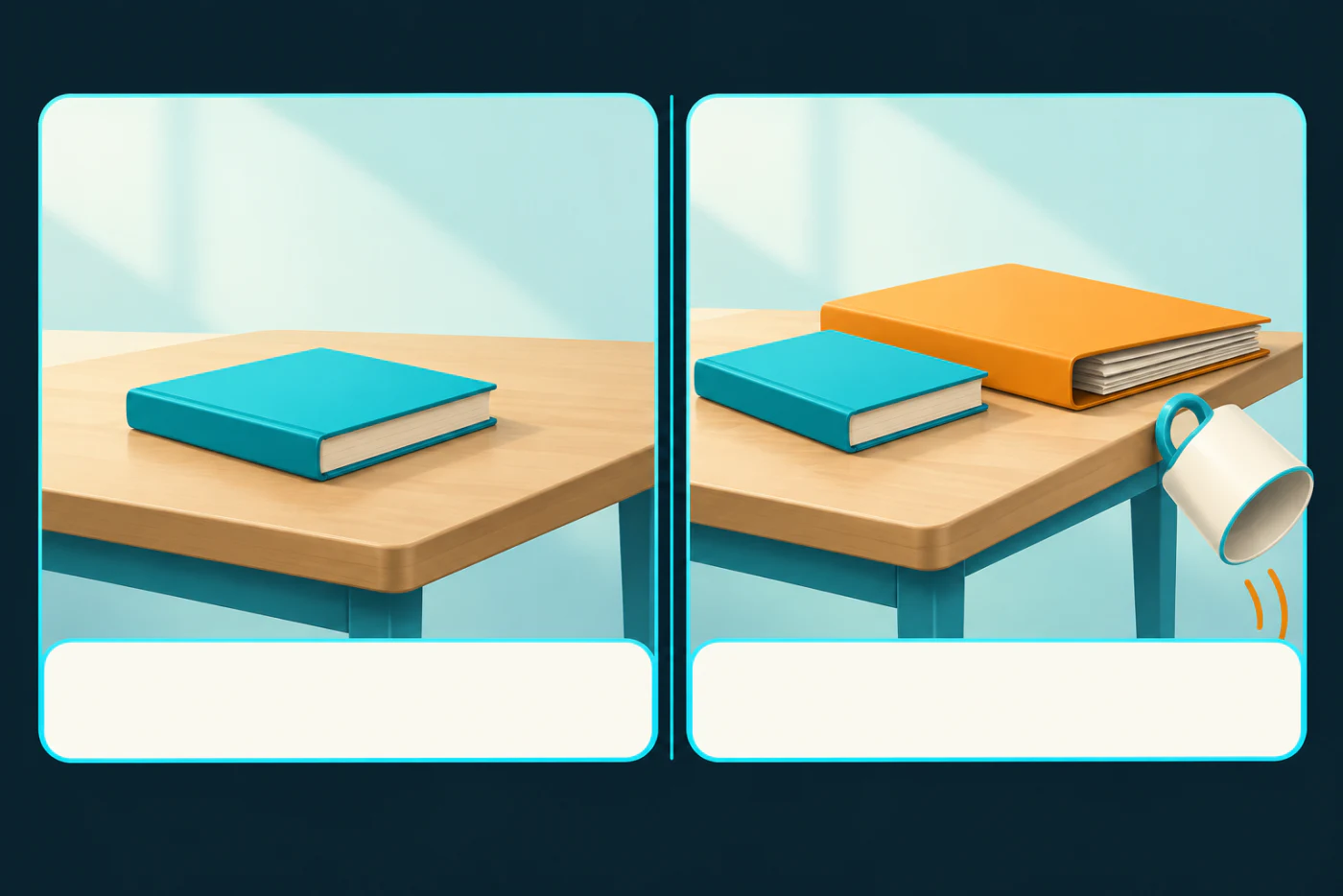 One instruction at a timeThree instructions in one sentence
Six ways to take the weight off
The first four work straight away; the last two need a week or two.
- One instruction at a time
“Fetch your socks” instead of three things in one sentence. The next instruction only after the previous one is done — it sounds slower and turns out faster.
- Have them repeat it in their own words
Saying the instruction back out loud moves it from your head into theirs. It takes three seconds and catches half the misunderstandings.
- Steps on paper, not in memory
For a longer task the child writes down a plan: three points in the margin. The paper holds the order instead of the workbench.
- Break the word problem up
First the question underlined, then the data written out, and only then the arithmetic. The question lies on the paper and cannot get lost.
- Take off the head what can be taken off
If the child works out every product from scratch, less room is left for the problem itself. A learnt times table frees the bench for the rest.
- Practise digits backwards
A short drill: you read a sequence of digits and the child repeats it from the end. Start with four and add one at a time. This exercise targets exactly that ability.
Music with lyrics, a television on and notifications take up the same room as the task. Quiet is not a parent's whim — it is space cleared on the bench.
One word problem, two approaches
A maths problem for a ten-year-old: “A shop had 240 apples. In the morning a third were sold, in the afternoon half of what was left. How many remain?”
Everything on the bench at once
- The child reads the whole problem and starts calculating immediately.
- 240 divided by 3 is 80. That leaves 160. Half of 160 is 80.
- And at that moment comes the question: “what was I supposed to work out?”. The question fell off the bench when the numbers arrived on it.
- The child goes back to the text, reads it from the start and calculates again — the whole way.
The bench cleared before the arithmetic
- The question underlined in the text and copied out separately at the top of the page: “how many remain?”.
- The data written in a column underneath: 240 · morning ⅓ · afternoon half of the rest.
- Only now the arithmetic — the question is on the paper rather than in the head, so there is nowhere for it to fall.
- After each step one number goes onto the page: 80 sold in the morning, 160 left, 80 sold in the afternoon.
- At the end the child looks at the copied-out question and answers: 80 remain.
The difference is not in maths ability — the same operations appear in both columns. The difference is how many things the child has to hold in their head at the same time.
Digits backwards — two minutes
It shows the difference between holding and processing better than any explanation. Do it together, including on yourselves.
- Four digits forwards
You read them aloud, one a second: 5 · 2 · 9 · 4. The child repeats them in the same order. Add one at a time until they stumble.
- Three digits backwards
A new set, but repeated from the end: 7 · 1 · 6 → the child says 6 · 1 · 7. Again add one at a time.
- Compare the two results
Write down two numbers: how many forwards, how many backwards.
- Do the same on yourselves
Ask the child to read to you. An adult has a limit here too, and seeing it changes the whole conversation about “you never listen”.
For almost everyone, backwards comes out two or three digits shorter than forwards, and that is a sign of nothing — it is precisely the difference between holding and processing. The result only means something as your own reference point: the same measurement in three months, at the same time of day, will show the change. Comparing with another child shows nothing.
This is not the test or a short version of it. Real digit-span repetition is part of standardised instruments with an established procedure and norms — a kitchen table has neither.
What the research says
Two papers: one on how this capacity grows, the other on what it cannot settle.
Gathercole et al., 2004 — working memory from 4 to 15
A study showing that the capacity of each component of working memory grows throughout the school years — and that the differences between children of the same age are large. Hence our caveat beside the table below.
Melby-Lervåg and Hulme, 2013 — a meta-analysis of working-memory training
Working-memory exercises improve performance on the exercises themselves and do not transfer to marks or to reading. That is why this text is about unloading the bench rather than enlarging it.
The research looked at working memory and its training, not at the Space Memory course. The practical conclusion is inconvenient for anyone selling courses, and it stays in the text: changing how tasks are presented does more than any amount of training.
The most common parental mistakes with a full bench
Four reflexes that look like help and add to the load.
Repeating the same thing louder
Volume does not make more room. Only splitting the instruction up, or moving it onto paper, does.
Three things in one sentence
“Take it, drop it off and bring me…” is three tasks. The child will do the first and stop — not out of stubbornness, but because the rest fell off.
Banning written steps
A sheet with a plan is not cheating. It is taking off the bench what did not need to be there.
Studying in the evening after a long day
At the end of the day and after a short night there is noticeably less room. The same task at five and at ten is two different tasks.
How many items a child holds
An approximate reference point, not norms — and not the result of our own measurements. Differences between children of the same age are larger than between year groups, and in the evening or after a short night the same head holds less.
| Age | How many items at once |
|---|---|
| 8–10 years | Usually 4–5 items at once |
| 11–13 years | Usually 5–6 items at once |
| 14–18 years | Usually 6–7 items at once |
See what this looks like for your child
The free test is three game-like tasks: memory, attention and reasoning. One of them shows exactly this — holding several things at once.
Open the free testshort test, about 7 minutes · no sign-up · instant result
Why we write about this separately
In Space Memory classes, part of what gets reported as “poor memory” turns out to be overload as the material goes in, not a failure to remember. Coaches then start by breaking tasks into steps, and the techniques come later.
Parents' questions
Can working memory be made bigger?
Skill at particular tasks does grow, and that shows in the exercises. We are more careful about promises that it transfers to every lesson — which is why we unload in parallel.
Is it the same as short-term memory?
Close, but not the same. Short-term memory stores for a while; working memory also lets you do something with it: rearrange, count, compare.
My child forgets instructions but remembers a whole series. How?
They watch the series in full and more than once, while the instruction is heard once, in passing and unconnected to anything. The difference is in repetitions and involvement, not ability.
Could this be a sign of something more serious?
Difficulty holding several things at once can be part of a bigger picture. A diagnosis is decided by a specialist, not by an article or an online test.
What about lists on paper — is that not cheating?
No. Adults do the same thing in a calendar. Paper frees up room for thinking; it does not replace thinking.
Where do we start this week?
With one instruction at a time and having it repeated back in their own words. Two changes that cost nothing, after which the arguments usually drop straight away.
Pages on what happens to the material next and what to do about attention.
Memory course for kids
The same techniques in weekly classes with a coach, on material from school.
Memory test for kids online
Check for free how your child remembers now — before you start practising.
Why a child forgets quickly
The route material takes from going in to coming back
How to check a child's memory
The same digits backwards, as a try at home
How to improve a child's concentration
When the work falls apart after five minutes
Would you like to see how we work on this in class?
Online classes run 90 minutes once a week, in groups of 5–10 children aged 8–18. Leave a request and we will tell you about the next group.
Request a callThis text explains the mechanism and does not replace a consultation if the difficulties are serious and cover everything at once.