








Why an association can fail to work
Three reasons an image evaporates faster than the material itself.
- The image stands still — “A yellow house” is a description, not a scene. There is nothing in it that could come back, because nothing happened.
- The image is someone else's — A ready-made association from a list online draws on somebody else's experience. The child has to memorise it first — adding work instead of removing it.
- One image for two things — The same dog used for two words forces a guess about which one was meant. An image has to lead to one answer.
Four marks of an image that stays
These four things tell you whether the association is ready.
Something happens in it
A verb rather than an adjective. The scene should have a beginning and an end, even if it lasts a second.
It is exaggerated
Size, number or sound clearly beyond the ordinary. The brain remembers departures from the rule, not the rule.
It belongs to the child
Built from their world: their school, their game, their dog. Your memories do not work on them the same way.
It leads to one thing
The image has one exit. If it fits two answers, the child guesses and loses trust in the method.
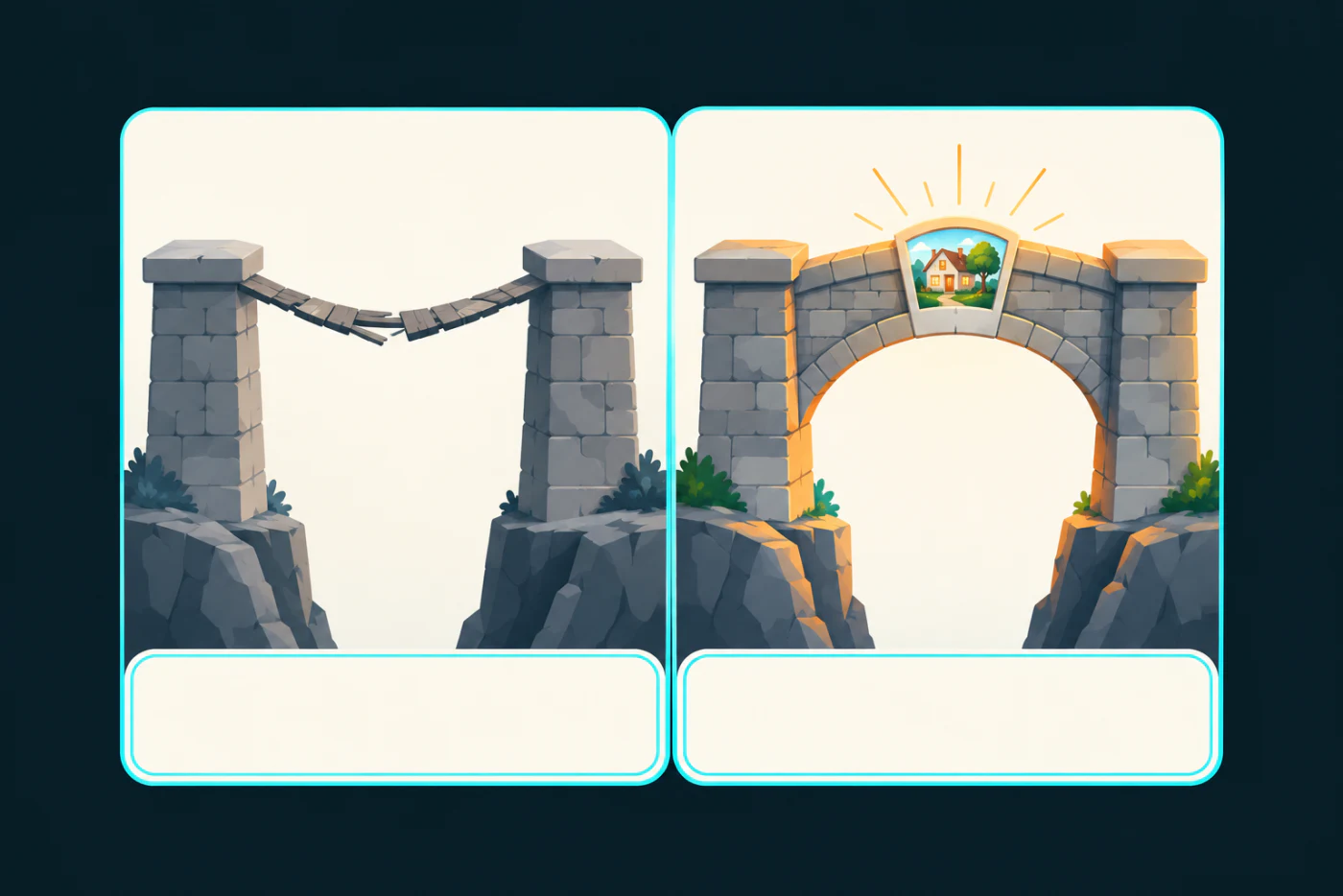 Sound aloneSound + scene
Six steps for one association
Take one difficult word or term and go through the steps out loud. The second time it will go without reading.
- Ask what it reminds them of
The child's first answer is the best one, even if it sounds silly. A sound, a shape, a classmate's name — anything will do.
- Turn it into a single scene
Not a collection of objects but an event: something falls, cracks, runs off, spills. Movement is what comes back later.
- Put the child inside it
A scene the child takes part in holds longer than one watched from the side. You can add a familiar place: your own kitchen, the playground, a grandparent's room.
- Exaggerate the size or the number
A single cat passes without a trace; forty cats climbing in through the window stay. Ordinariness is an image's worst enemy.
- Check it the other way round
You say the image, the child gives the meaning. If it does not work in that direction, the image needs fixing — better to know now than during a test.
- Come back after ten minutes and in the evening
Two short returns on the same day decide whether the image survives the night. In the morning the question about the meaning is enough on its own.
Not every word needs an association. If the child remembers something straight away, building an image is a waste of time — the technique exists to deal with material that does not stick.
Two associations for the same word
The word “gist” — the child has to remember that it means the most important part of the matter. Two bridges to the same meaning.
A bridge that will collapse
- The association: “gist sounds like gift”.
- The image: a wrapped present lying on a table.
- Nothing happens in it, the child is not in it, and it leads only to the sound, not to the meaning.
- Two days later what is left is “something with a present”, and it is not clear which word it was for.
A bridge that stands
- The same sound: “gist” — “gift”.
- The scene: the child tips a box of a hundred presents onto the table, a parent says “keep one gift, that one is what matters”, and all the rest slide off the edge with a crash.
- Something happens in it, it is exaggerated, the child is inside it, and the scene leads to one meaning: the most important part.
- The check in reverse: the parent says “the most important part of the matter” and the child answers “gist”.
- A return after ten minutes and again in the evening, a few seconds each.
The difference is not inventiveness. The scene on the right meets all four conditions from the block above; the one on the left meets none except the sound — and that can be checked in five seconds, before the child starts learning.
Build one association — two minutes
Take a word the child does not know, or a term from tomorrow's lesson.
- A question, not a prompt
“What does this remind you of?” You wait in silence, even for ten seconds. The first thing the child comes up with is the right one — correcting it into something prettier kills the whole effect.
- One scene, not a description
From that similarity you make a situation where something happens. A helping question: “who is doing it and what happens then?”
- Put the child inside and exaggerate
They should be in the scene, and the size or the number should be absurd.
- Check it in reverse
You give the meaning, the child has to produce the word. Not the other way round — that is the harder direction and the only one that shows anything.
If the reverse direction worked straight away, the bridge stands and one return in the evening is enough. If it did not, check the scene against the four marks in the block above — usually movement is missing, or the scene leads to two things at once. Fixing it takes thirty seconds and costs less than repeating the word ten times.
Do not do this with a whole list at once. One association a day for a week gives more fluency than twenty in one evening — and fluency is the goal here, not the words themselves.
What the research says
Two papers behind the way we build the bridge.
Atkinson, 1975 — the keyword method
Exactly this procedure: a new word gets a similar-sounding familiar one and then a scene linking it to the meaning. The method came out ahead of ordinary repetition of pairs.
Roediger and Karpicke, 2006 — retrieval from memory
Checking from memory holds material longer than rereading. Hence the fifth step: from meaning to word, rather than another look at the pair.
The research looked at the technique, not at our course, and mostly with adults learning a foreign language. With a child the first scenes are built together — inventing them alone comes after a dozen or so attempts.
The most common mistakes when building associations
Four reasons the bridge falls apart in two days.
An image handed over by an adult
Somebody else's association has to be memorised first, so it adds work instead of removing it. The parent asks “what does this remind you of” rather than supplying the answer.
An image where nothing happens
“An apple on a table” does not stay. Movement and exaggeration are what memory notices.
One image for two things
If the same scene leads to two words, the wrong one will come up at random. One scene — one meaning.
An association never checked in reverse
From image to word is easy. The harder and necessary direction is the reverse: from meaning to word — and only that shows whether the bridge stands.
How long this takes
Time per association at successive stages of practice.
| Stage | How long |
|---|---|
| First attempts | 1–2 minutes per image, together with a parent |
| After a week of practice | 20–30 seconds, the child builds it alone |
| On real material | 10 words in fifteen minutes or so, with two returns |
See how your child works with images
The free test is three game-like tasks: memory, attention and reasoning. One of them rests on visual patterns — the result shows whether this is a strength or something to practise.
Open the free testshort test, about 7 minutes · no sign-up · instant result
Why we start with this
Association is the first technique in Space Memory classes, because all the others stand on it: a chain is associations joined into a sequence, a route is associations placed along points. A child who can build an image in half a minute learns the next techniques in one evening.
Parents' questions
From what age can this be taught?
From eight it goes consciously, with rules and checking both ways. Younger children make images spontaneously but find it harder to repeat them on purpose.
What if the child's associations are odd or rude?
They hold all the better for it and there is no reason to correct them. Just agree that they stay at home rather than coming out in class.
Will they confuse the image with the fact?
No, as long as you check in reverse straight away. The image is the route to the answer, and the answer comes out in ordinary words.
Does this work with abstract terms?
Yes, through the similarity of sound or through a situation where the term comes up. The more abstract it is, the more important it is that the child is in the scene.
How many associations per session?
Five to seven. With longer lists the quality of the images drops, and the whole technique with it.
Do they have to be written down?
At first yes, in one sentence — that lets you come back and see which image failed. After a few weeks writing them down stops being necessary.
Pages where an association turns into a bigger technique.
Memory course for kids
The same techniques in weekly classes with a coach, on material from school.
Memory test for kids online
Check for free how your child remembers now — before you start practising.
Memorising techniques for kids
Which technique fits which kind of material
The memory palace for kids
Associations placed along a familiar route
How to memorise vocabulary
The same method on language material
Want to practise this with a coach?
In online classes the child builds associations on their own material and shows them to a group of 5–10: 90 minutes once a week, with short sessions in between. Leave a request and we will tell you about the next group.
Request a callThe tutorial is free. Classes help when the child understands the method but does not use it on their own.