









The two halves of preparation
The first is obvious and everyone does it. The second decides the mark and almost nobody does it.
- Learning the material — Reading, notes, review. Everyone does this, and it is the part people mean when they say “I revised”.
- Working on the format and the mistakes — Establishing the scope, a mock test under conditions close to the real thing, and going through the returned paper. It costs about an hour for a whole test, and usually nobody does it.
Three gaps in typical preparation
The material gets covered and the result is still lower than the work would suggest.
Nobody knows what will be examined
The student revises the whole chapter because nobody asked about the scope. Half that work has no counterpart on the paper.
Preparation with no mock
The knowledge was never checked under the conditions where it will be needed: timed, without notes, with the question phrased in somebody else's words.
The paper comes back and goes into the bag
A marked test is the cheapest source of information about what to revise next — and the one most often left unopened.
Six steps, counting from four days before
For a short quiz two days is enough; for a whole-topic paper it is worth starting a week ahead.
- Establish the scope and the format
Written down in the lesson or asked of the teacher: which topics, how many questions, whether there will be problems. One question saves several hours of revising the wrong thing.
- Gather the material in one place
Exercise book, textbook, worksheets, photos of the board. Hunting for things mid-study is what stretches the evening most.
- Work in portions of 20–25 minutes
With a short return to yesterday's portion at the start of each new one. The return takes five minutes and replaces the whole review at the end.
- Sit a mock test the day before
Ten questions built from your own exercise book, paper, a clock, no notes. The questions are set by the student or by a parent — both versions work.
- Work only on what went badly
The rest is ready and needs no more time. This is the one moment when narrowing revision to a few points is allowed.
- The evening before: twenty minutes and stop
Self-testing from the list of mistakes, then the book closed and sleep at the usual time. Adding material after that hour usually takes more than it gives.
If the mock goes badly across the board, there is no point rescuing it in one evening. Then it is more honest to work through half the material properly than all of it superficially.
Four days before a history quiz
The same material and the same number of hours. The difference is in the second half of the preparation.
Preparation with no mock
- Days 1–3: reading the chapter and the notes, forty minutes a day.
- Day 4 in the evening: one more read of the whole thing.
- In the quiz three questions are phrased differently from the exercise book and two are about a topic the teacher never announced.
- What is left afterwards is a mark and the feeling “I revised and it still went badly”. The paper goes into the bag.
The same thing with a mock and work on mistakes
- Day 1: fifteen minutes to establish the scope and gather the material in one place. It turns out one of the three topics is outside the scope.
- Days 1–3: portions of twenty minutes, each starting with a short return to yesterday's.
- Day 3 in the evening: the mock — ten questions from their own exercise book, paper, a clock, no notes within reach.
- The same evening, twenty minutes: only the four questions that went badly get worked on.
- Day 4: self-testing from the list of mistakes, and stop. Sleep at the usual time.
The second version takes less time, because days three and four go only on what did not work. Without a mock there is no way of knowing what that is — so everything gets repeated.
Build a mock test — twenty minutes
The most important of the six steps and the only one no amount of rereading can replace.
- Ten questions from their own exercise book
Set by a parent or by the child the day before. The questions should be about what was covered in class and phrased differently from the notes — otherwise you are testing memory for sentences, not knowledge.
- Paper, a clock, no notes
Conditions close to the real thing: no prompts, no looking, within a set time. That is the entire value of a mock.
- Mark it together and write out the mistakes
Not a score — a list. Four items that went badly.
- Twenty minutes that same evening, only on those
The rest of the material is ready and needs no more time.
The outcome of a mock is not a number of marks but a list of what is left to do — usually three or four things instead of a whole chapter. If more than half went badly, that is information that you started too late, and the best decision then is to pick the two most important topics rather than trying to rescue everything.
The mock goes the day before, not on the day of the test. The point is that there is still an evening left to fix what went wrong.
What the research says
Two papers behind the fourth step — the one with the mock test.
Roediger and Karpicke, 2006 — retrieval from memory
The act of testing itself improves later recall more than another read of the material, and the advantage grows over time. A mock test is not a check before the real one — it is the most effective part of the revision.
Dunlosky et al., 2013 — a review of ten learning techniques
Self-testing under conditions close to the exam was among the highest-rated techniques. Hence the requirement: paper, a clock and no notes within reach.
The research looked at the technique, not at our course. Sorting mistakes into three kinds — carelessness, missing knowledge, a misread instruction — does not come from those papers; it is practice that stops you treating one with the cure for another.
What to do with the returned paper
Fifteen minutes after the test comes back saves several hours before the next one.
Sort the mistakes into three kinds
Carelessness, missing knowledge, a misread instruction. Each kind needs something different, and together they just look like a poor mark.
Carelessness — change the procedure
Read the instruction twice, underline the question, one minute to check at the end. This is not a matter of knowledge.
Missing knowledge — go back to the topic
One topic, twenty minutes, self-testing. Not the whole chapter — only the place where the paper showed a gap.
A misread instruction — practise the format
A few instructions from the textbook read and retold in their own words, without solving anything. A surprisingly common reason for lost marks.
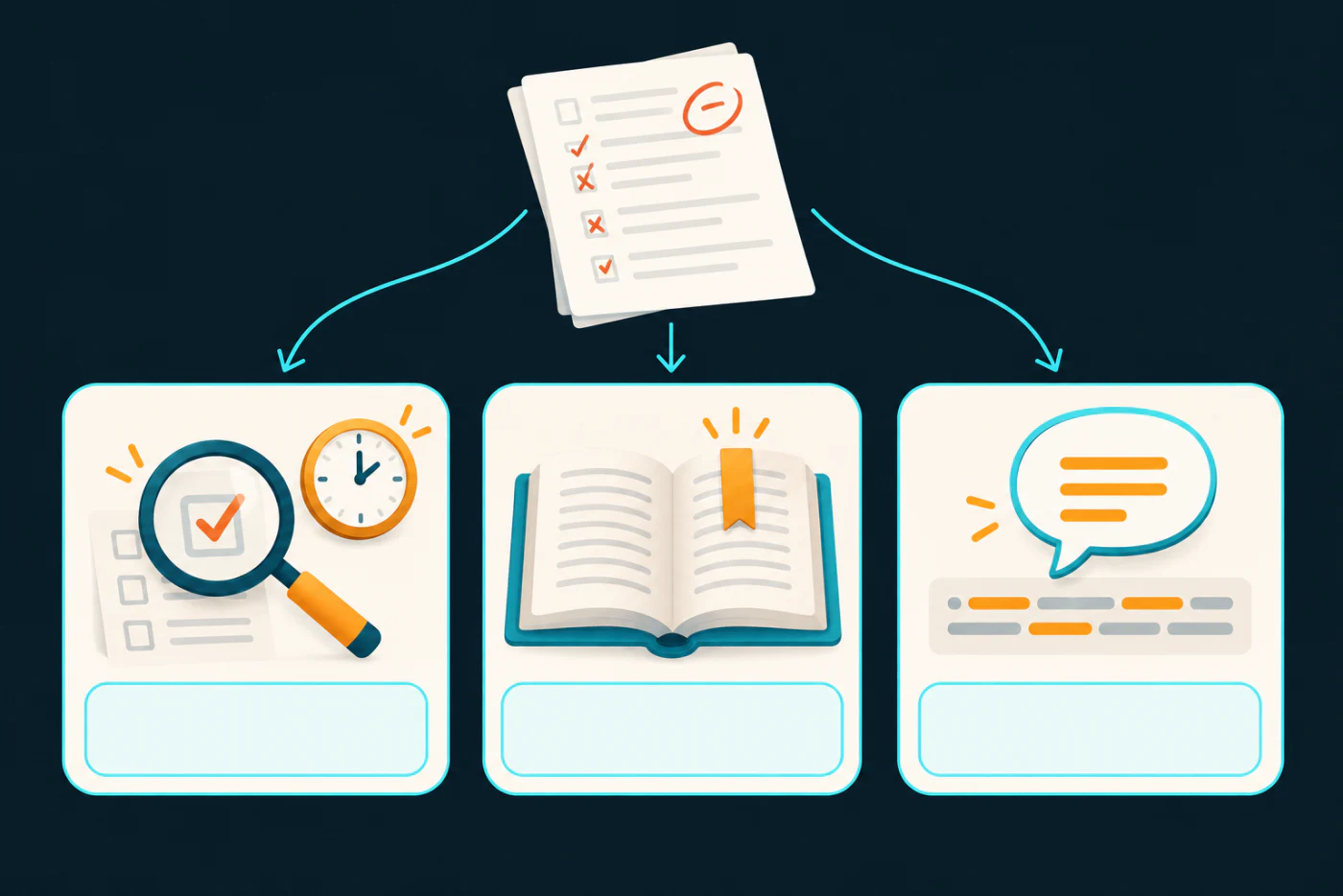 Carelessness — change the procedureMissing knowledge — back to the topicInstruction — practise the format
How long each step takes
The real cost for an ordinary test on one topic.
| Stage | How long |
|---|---|
| Establishing the scope and gathering material | 15 minutes, once |
| The mock test | 20–30 minutes, the day before |
| Working on the mistakes | 20 minutes the same evening |
See how work against the clock goes
The free test is three short game-like tasks: memory, attention and reasoning. It is the closest thing to what happens in an exam room.
Open the free testshort test, about 7 minutes · no sign-up · instant result
Why we insist on the mock
Because in Space Memory classes the difference between a student who “went through the material” and one who sat a mock is visible immediately. The first knows they revised. The second knows what they still cannot do — and that is the only information worth having the day before.
Questions from students and parents
Who should set the questions for the mock?
Ideally the student, because setting a question requires understanding the material. A parent is useful where the questions need to come at random rather than in order.
Does a mock test add stress?
It usually works the other way: a familiar situation is less stressful than an unfamiliar one. There is one condition — the mock result is neither marked nor commented on.
How many days ahead should we start?
A short quiz: two days. A topic test: four or five. A whole-term paper: two weeks, split by topic.
What should they do on the morning of the test?
Go through the list of mistakes from the mock, out loud, for five minutes. No new material in the morning.
My child panics despite being prepared. What helps?
A timed mock, a prepared first sentence and a plan for which questions to start with. With strong, recurring anxiety it is worth talking to the school counsellor.
Is revising in a group before a test worth it?
Yes, if the group tests each other. No, if it turns into comparing who knows more.
Pages on the material itself, the order of studying and the weekly plan.
Effective study course for kids
Learning as a skill: planning, review and self-testing in class.
How to memorise material for a test
Three piles and a five-day plan
How to study effectively
The order in which studying gets sorted out
Study techniques for teenagers
The same logic on a larger body of material
Would you like this in place permanently?
On the study-skills course the student prepares for real tests with a coach: 90 minutes once a week, in a group of 5–10. Leave a request and we will tell you about the next group.
Request a callAll of the above is done without us. The course is for those who want this in place permanently, not before one test.