






When to use a mind map and when not to
It works best with topics where connections matter.
- Helps: topics with connections — Causes and effects of events, structure and function, features of concepts, an essay plan. You can see the whole and the place of each part.
- Helps: revision before a test — A whole unit on one sheet — it is easy to check what you do not remember.
- Does not help: vocabulary, formulas, long strings of dates — Flashcards and spaced repetition, mnemonics or a timeline work better here — we describe them in the text memorisation techniques for school.
- Does not help: a beautiful map with no recall — Drawing and decorating without recalling from memory gives less than the same time spent testing yourself.
A mind map example for kids: photosynthesis (biology, primary school)
This is how a map on one textbook topic might look.
Main branches
- What is needed — light, water, carbon dioxide.
- Where it happens — leaves, chloroplasts.
- What is produced — glucose and oxygen.
- What for — food for the plant, oxygen for us.
What to add on the smaller twigs
- A drawing of the sun next to the word “light”.
- An arrow from “oxygen” to “breathing”.
- Green colour next to the word “chlorophyll”.
- One question to yourself: “what happens in the dark?”.
How to make a mind map in five steps
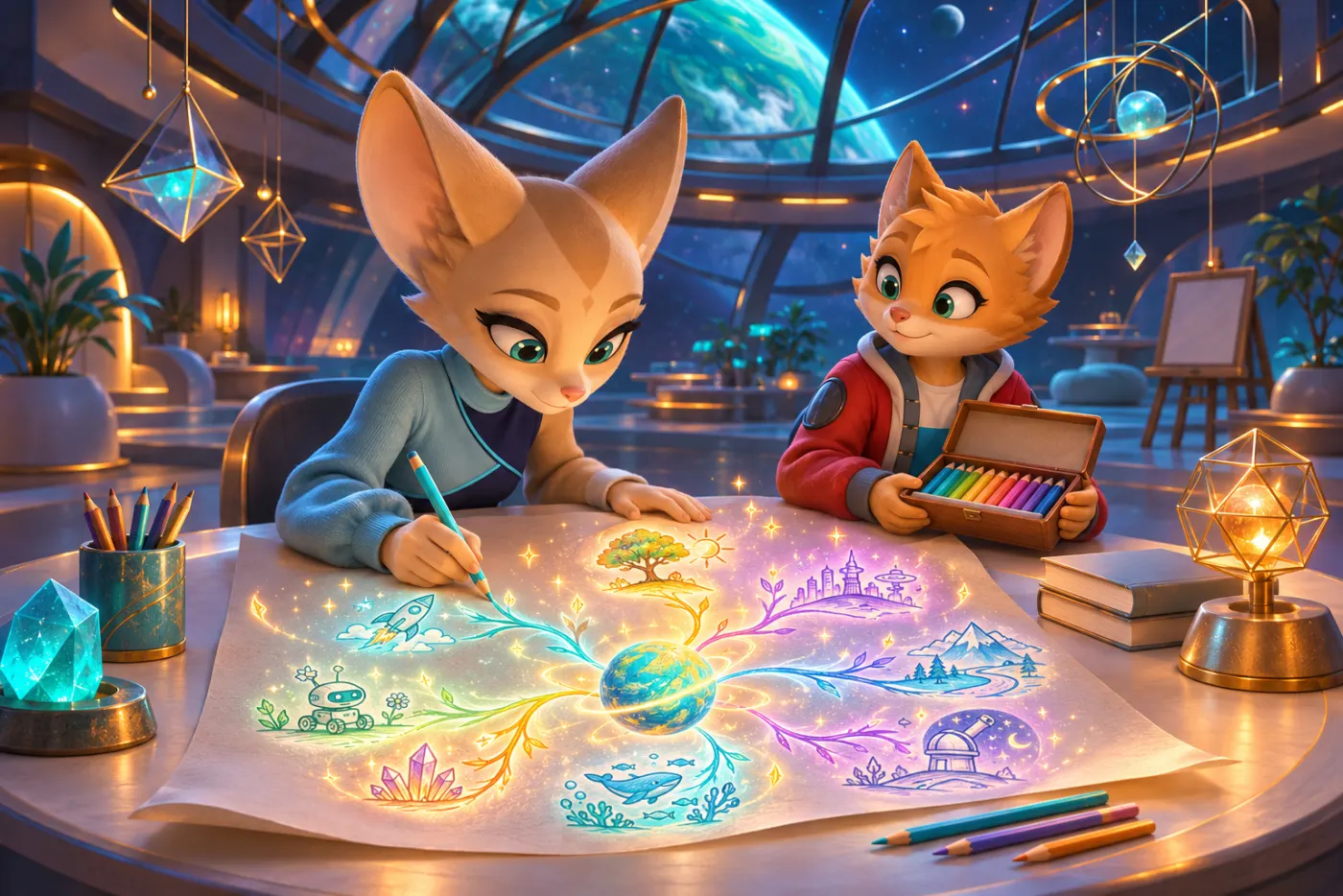
You need a landscape A4 sheet and a few coloured pens.
- The topic in the middle
One or two words and a small picture in the middle of the sheet — e.g. “Photosynthesis” and a leaf.
- Main branches: 3–6
The most important parts of the topic, each in a different colour. One word per branch, not a whole sentence.
- Details on smaller twigs
Thinner twigs come off the main branches with facts, examples and numbers. Keywords, not a copied textbook.
- Pictures and arrows between branches
A small symbol next to an important keyword and an arrow where one thing affects another. A picture is easier to remember than a word.
- Close it and draw from memory
Put the map aside and draw it again on a clean sheet — a younger child can instead tell the map aloud, pointing a finger at the empty places on the sheet. Compare what is missing and add only that. This step makes the biggest difference.
The result is a second map, drawn from memory and placed next to the first. What is missing from it is exactly what needs to be revised — usually one or two twigs, not the whole topic. If a whole main branch is missing, go back to that part of the textbook and draw the map from memory once more three days later.
What the research says
Maps help, but recalling from memory works more strongly.
Nesbit and Adesope, 2006 — a meta-analysis of concept maps (close to mind maps)
In 55 studies, from grade 4 to university, learning from concept maps gave on average better retention than reading a text, a lecture or a discussion; the effect depended on how they were used. Mind maps are close to concept maps, but they are not the same thing.
Farrand, Hussain and Hennessy, 2002 — mind maps in students
Medical students (50 people) who studied with the mind map technique recalled facts from a text better a week later than the group studying in their own way, but rated the method as less motivating.
Karpicke and Blunt, 2011 — recall from memory and concept maps
Students who recalled a text from memory did better a week later than those who spent the same time making concept maps with the text in front of them — even when the test was to draw a map. That is why the last step — drawing the map from memory — is the most important.
From what age, and how to start
Three things parents ask about.
Younger children, 8–10
A simple map with 3–4 branches and pictures instead of words. It is best to make the first maps together with the child, on a topic they find interesting.
Older children, 11–18
Up to six main branches and short keywords instead of pictures. How to fit a map into a revision plan — how to memorise material for a test.
The map and other techniques
The map organises the topic, and for the details mnemonics come in handy. Which technique to choose for what — in the text memorising techniques for kids.
How we teach this at Space Memory
Space Memory is an online school where children and teenagers learn to remember, focus, read faster with understanding and plan their study — always on the material they have at school right now. What we described above, the child practises with us step by step, with a coach.
- Online classes with a coach once a week, in a small group
- Short daily practice on the platform — parents see which days are done
- To start: a free test and a free trial lesson
Before your child starts drawing maps
The free test is two short games: digits forwards and backwards (working memory) and matrices (logic). You can come back to the result after a few weeks of practising with maps.
Open the free testshort test, about 4 minutes · no sign-up · instant result
How we teach this at Space Memory
In class, children practise memorisation techniques and recalling material from memory, using examples from school.
Questions from students and parents
Can a mind map be made on a computer?
Yes, in mind-mapping software. By hand, though, you have to choose the keywords yourself, and that is already work with the material — so to begin with a sheet of paper and coloured pens are better.
How long does it take to make a mind map?
For one textbook topic usually 15–20 minutes. If it takes much longer, the child is probably copying sentences instead of keywords.
Does a mind map replace notes in an exercise book?
It does not have to. A mind map works well as a second set of notes next to the exercise book — for revision before a test.
Mind map or flashcards?
Mind maps and flashcards serve different purposes: the map is for topics with connections, flashcards for vocabulary, definitions and dates. Many children use both.
More on memory
- How to improve a child's memory
- Sleep and memory in children
- How to memorize a poem
- How to learn vocabulary
Other ways to remember school material.
Memory course for kids
The same techniques in weekly classes with a coach, on material from school.
Memory training for kids
What memory training is and what a child practises in class.
Memory test for kids online
Check for free how your child remembers now — before you start practising.
How to memorise material for a test
A review plan and testing yourself.
Mnemonics for kids
Associations, stories and images for the details.
The Space Memory method
How we match techniques to a child’s age.
Would you like your child to practise maps and other techniques with a coach?
In class, the child draws maps on topics from current lessons and recalls them from memory together with the coach. The manager will confirm the price.
Request a callA mind map is one technique, not a method for everything — for vocabulary or formulas, other approaches work better.