
Lessons
What Space Memory lessons look like: a lesson step by step
Updated:
A lesson lasts 90 minutes and takes place online once a week, in a group of 5–10 children, with a coach in real time. Every lesson follows the same rhythm: a homework check, a short warm-up, a new technique practised on the platform, and, at the end, a block on public speaking and working with information. Below we describe it step by step, following the programme our coaches use.
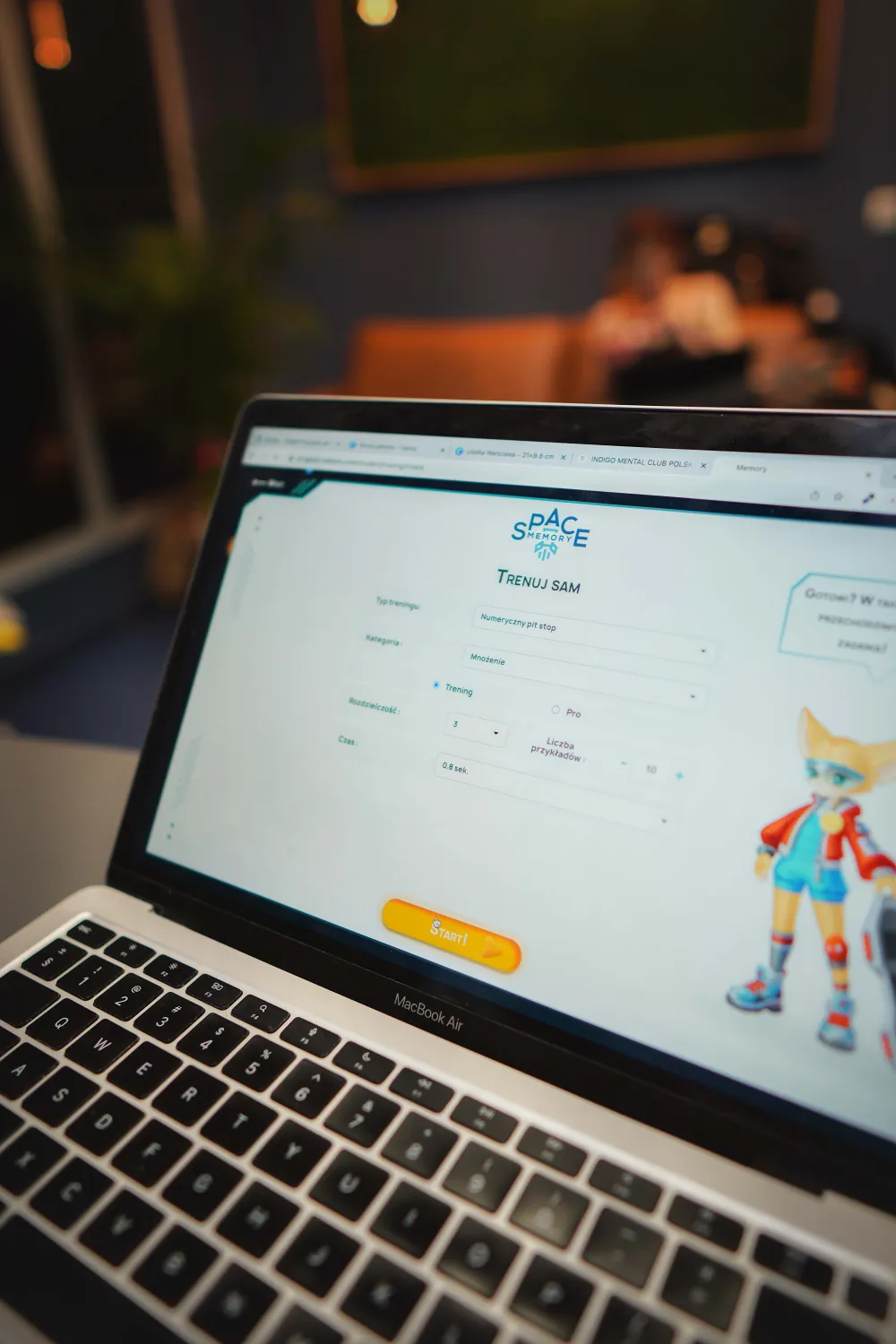
How one lesson runs
| Stage | What happens |
|---|---|
| 1. Homework check | The coach looks at what the child did on the platform during the week and briefly goes over the results with the group. |
| 2. Brain gym | A few minutes of movement and coordination exercises to warm up before working with the head, in the form of an on-screen game. |
| 3. Energiser game | A short game for the whole group so that the children get into the rhythm of the lesson and start answering out loud. |
| 4. Checking the previous technique | The coach questions each child separately and times them on the platform. Meanwhile the rest of the group does an attention task, such as a crossword, a word search or drawing from memory. |
| 5. New technique and practice | The coach shows a new portion of the technique on the shared screen and works through the first example, then the children practise on their own on the platform, with the number of items and the speed set to suit the group. |
| 6. Leadership skills | A block on public speaking and working with information: presenting, giving a short speech, taking feedback, telling opinion from fact, and using AI tools sensibly. |
The order never changes, so after a few weeks the child knows what to expect. What changes is the content: each lesson adds a new portion of the technique or a new kind of material.
What a child learns in the lessons
- The number-letter code — every number from 00 to 99 gets its own image. The child learns it in batches of ten numbers, and then memorises long strings of digits, four-digit numbers, dates and formulas. More: mnemonics for kids.
- The Roman room and routes — objects in a familiar room or successive places along a route serve as shelves for information: from 10–20 locations at the start up to a personal route of 50 locations. More: the loci method and the Roman room, the memory palace.
- Words and associations — word pairs, foreign-language vocabulary through associations, poems written down as pictograms. More: the association method, how to learn a poem.
- Pictures, colours and tables — memorising pictures, colour sequences and tables of pictures, including in Olympiad mode, against the clock.
- Phonetic coding — turning difficult names into similar-sounding associations: the world's biggest cities, chemical elements.
- Mind maps — the rules, and maps of a book, a film and a literary work. More: mind maps for kids.
- Speed reading — in the second part of the programme, with tempo and comprehension measured. More: speed reading for kids.
- Attention and logic — the Stroop test, Schulte tables, matchstick puzzles, logic problems and talking them through.
The course programme: 56 lessons
The programme has 56 lessons and is spread over about 12 months. Techniques are added gradually, and each stage ends with an assessment.
| Stage | What the child learns |
|---|---|
| Lessons 1–11 | Number-letter code 00–30, the Roman room and first routes of 10–20 locations, memorising pictures, the Schulte table. Lesson 11 brings the first assessment. |
| Lessons 12–22 | Code up to 50, four-digit numbers, poems with pictograms, the “Wonders of the World” route, word pairs, phonetic coding. Assessment in lesson 22. |
| Lessons 23–33 | Code up to 70, percentages, cipher texts, mind maps, memorising colours, speaking to camera. Assessment in lesson 33. |
| Lessons 34–45 | Code up to 99, English words through associations, chemical elements, an introduction to speed reading, a personal route of 50 locations. Assessment in lesson 45. |
| Lessons 46–56 | Olympiad preparation, tables of pictures, mathematical formulas, facts about writers, the next stages of speed reading, a word-memorising assessment. |
On top of the assessments, the programme includes eight check-up tests spread over every few weeks. They let the coach and the parent see how the child's results change.
Homework: short, five days a week
After each lesson the child gets tasks on the platform laid out over five days, about 10 minutes a day. Usually these are:
- number-letter code practice, with the number of items and speed set for each day;
- memorising pictures, words or associations;
- short mental-arithmetic tasks (“Pit Stop”);
- sometimes a small creative task, such as preparing a one-minute talk.
Parents can see every completed exercise in the profile, along with the days with and without practice, with no need to ask “did you practise?”.
See the lessons on video
We show extracts from lessons, comments from pupils and parents, and Olympiads on the Video page. But the best way is to see a lesson for yourself: we arrange a demo lesson on request, so your child can try it and you can see how the coach works.
Questions about the lessons
What if my child misses a lesson?
One lesson a month can be made up. We send the material, and the coach returns to it at the next meeting; the platform exercises are available at all times.
What does the child do in a lesson?
After the homework check and a short warm-up, the coach questions each child on the previous technique, shows a new one, and the children practise it on the platform. At the end there is a block on public speaking and working with information.
How long does the whole course last?
About 12 months, that is 56 lessons once a week. The agreement can be terminated with effect from the end of a calendar month.
Does my child need a camera?
Yes, a computer or tablet with a camera and a stable internet connection will be needed. A phone is enough for the lesson itself but awkward for the platform exercises.
How do you track progress?
The programme has eight check-up tests and assessments at the end of each stage, and the daily exercises are visible in the parent profile.
See a lesson for yourself
Leave a request and a manager will find a group and arrange a demo lesson. Price: ≈ $94 for the first month, then ≈ $125 a month; the manager will confirm the exact price.
See also: Courses for kids · Coaches · Prices · The Space Memory method